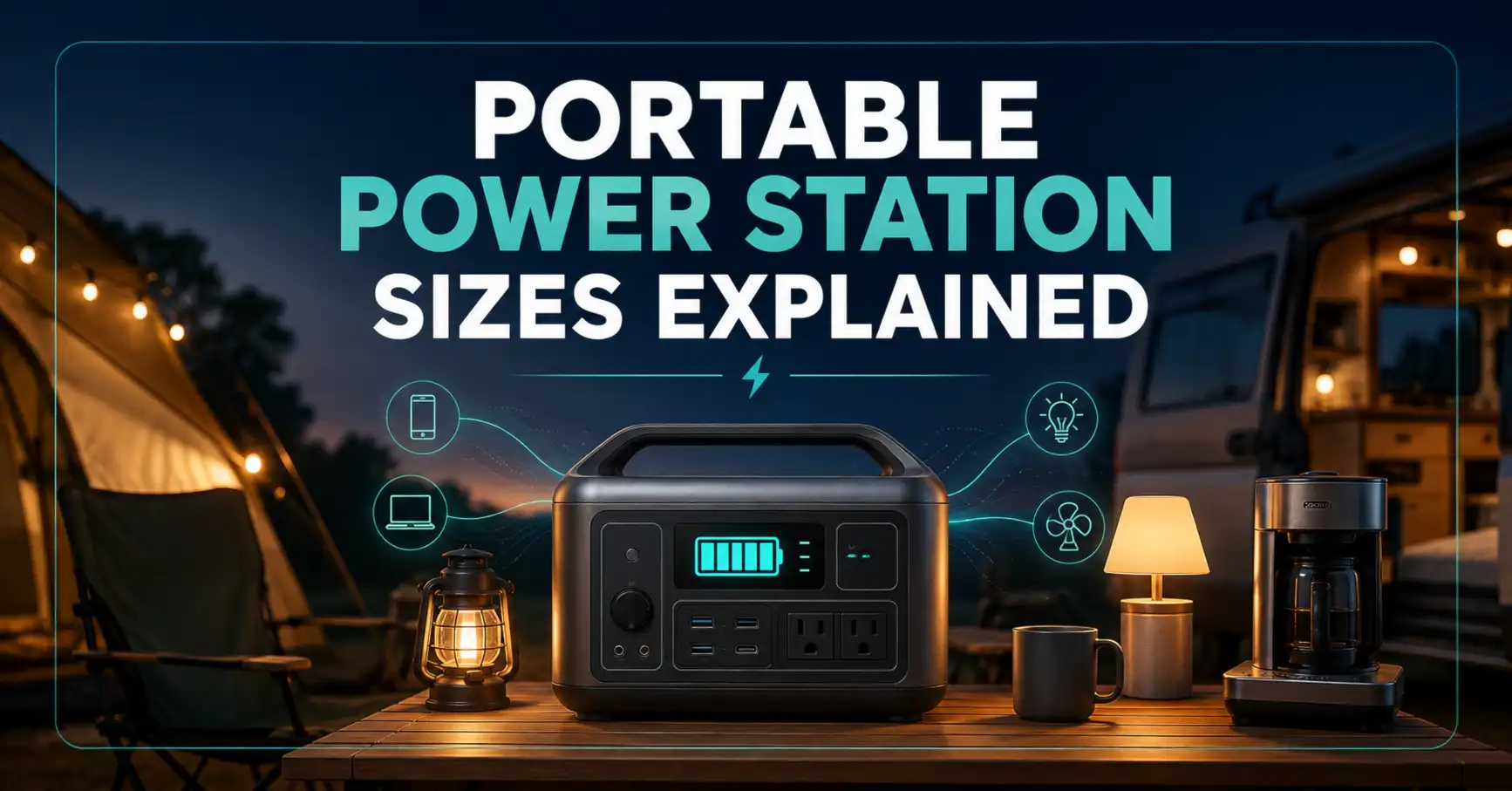
Portable Power Station Sizes Explained: How Many Watt-Hours Do You Actually Need?
If you’re comparing portable power stations, the size labels can get confusing fast. A model might advertise 300Wh, 1,000Wh, 2,000Wh, or more, while another number tells you its output in watts. I look at both numbers because they answer two different questions: how long the battery can run your gear and whether it can power that gear in the first place.
Why You Can Trust This Guide
I use manufacturer specifications, support documentation, and authoritative energy sources to check the technical details in my guides. I separate battery capacity in watt-hours from power output in watts, avoid treating marketing estimates as guaranteed runtime, and use conservative assumptions for real-world losses. When I give runtime examples, I treat them as planning estimates because actual results vary with appliance behavior, inverter efficiency, temperature, battery management limits, and the condition of the equipment.
The two numbers that matter most
When I size a portable power station, I start with two specifications:
- Rated battery capacity in watt-hours (Wh): this tells me how much energy the battery is rated to store, while usable energy at the outlets will generally be lower.
- AC output in watts (W): this tells me how much power the station can supply at one time.
The U.S. Department of Energy makes the same distinction for energy-storage systems: energy capacity describes how much energy can be stored, while power capacity describes how much can be delivered at a given moment. You can read the DOE overview here: Solar Energy and Storage Basics.
This is why I do not choose a power station by watt-hours alone. A large battery can still be the wrong choice if its inverter cannot handle the running or startup wattage of the appliance you want to use.
Quick answer: what size power station do I need?
- Phones, laptop, lights, router: I usually start around 300–500Wh.
- Camping and longer electronics use: I usually look around 500–1,000Wh.
- Refrigerator plus basic outage essentials: I usually start around 1,000–2,000Wh, after checking refrigerator surge power.
- Multiple appliances or longer outages: I look at 2,000Wh+ or an expandable system.
These are starting points, not guarantees. I still check the actual wattage, runtime, and startup surge of the equipment I plan to power.
What watt-hours actually tell you
A watt-hour is a unit of energy. In simple terms, one watt-hour is the energy used by one watt of power for one hour.
So, in perfect laboratory-style math, a 1,000Wh battery could run a steady 100W load for about 10 hours:
1,000Wh ÷ 100W = 10 hours
Real life is less generous. Energy is lost through the inverter and other electronics, and some power stations reserve part of the battery capacity for protection. That is why I never treat the simple division result as a guaranteed runtime.
Jackery’s current support guidance, for example, uses a rough estimate of battery capacity × 0.8 divided by device power consumption for stable loads. I treat that as a useful conservative shortcut rather than a universal rule: Jackery runtime guidance.
My simple sizing formula
For a steady AC load, I often use this quick planning formula:
Device watts × hours needed ÷ 0.8 = approximate minimum battery capacity in Wh
For example, if I want to run a 100W device for eight hours:
100W × 8 hours ÷ 0.8 = 1,000Wh
I then separately check whether the station’s continuous output and surge output can handle the appliance. The formula estimates energy capacity; it does not tell me whether the inverter is powerful enough.
🎬 Watch: How to Choose the Right Portable Power Station Size
Not sure how watt-hours translate into real-world runtime? This video explains how to estimate your power needs and choose a portable power station that fits the devices you actually plan to use.
Illustrative runtime estimates using an 80% planning factor
This table is only a calculation example. The device wattages below are hypothetical planning loads, not expected consumption for every router, laptop, light, fan, TV, or medical device. I’m using 80% of rated capacity as a conservative planning assumption, and actual runtime can be higher or lower.
| Device example | Example planning load | 300Wh station | 500Wh station | 1,000Wh station | 2,000Wh station |
|---|---|---|---|---|---|
| Wi-Fi router | 15W | ~16 hours | ~27 hours | ~53 hours | ~107 hours |
| Laptop | 60W | ~4 hours | ~6.7 hours | ~13.3 hours | ~26.7 hours |
| LED lighting | 20W | ~12 hours | ~20 hours | ~40 hours | ~80 hours |
| Small fan | 40W | ~6 hours | ~10 hours | ~20 hours | ~40 hours |
| TV | 100W | ~2.4 hours | ~4 hours | ~8 hours | ~16 hours |
I leave CPAP machines and refrigerators out of this generic table because their real-world power needs can vary too much for a single wattage assumption to be responsible. I size those separately below.
Portable power station size ranges I use as a starting point
There is no single official industry definition for “small,” “medium,” or “large” portable power stations, so I use these ranges as practical shopping categories rather than strict standards.
Under 500Wh: small and highly portable
I think of sub-500Wh models as personal electronics and light-duty backup units. They make sense when portability matters more than long runtime.
- Phones and tablets
- Laptops
- LED lights
- Wi-Fi router and modem
- Camera batteries
- Small fans
A 300Wh station running a steady 50W load has a simple theoretical runtime of six hours. If I plan with roughly 80% usable energy, that falls closer to 4.8 hours.
500Wh to 1,000Wh: everyday backup and camping
This is the range I usually look at for longer electronics use, camping setups, and short outage support. It gives me noticeably more breathing room without moving into the heaviest class of power stations.
- Multiple phones and laptops
- Router plus lights
- TV or small entertainment setup
- CPAP, depending on actual consumption and humidifier use
- Small kitchen appliances if the inverter output is sufficient
1,000Wh to 2,000Wh: serious outage support
Around 1,000Wh is where portable power stations start becoming much more useful for household outage planning. I consider this range when the goal is to keep several essentials running rather than simply recharge electronics.
- Refrigerator support
- Router, phones, and laptops together
- Lighting for multiple rooms
- TV and communications equipment
- Selected medical or mobility equipment after checking exact requirements
2,000Wh and above: large portable or expandable backup
Once I get into 2,000Wh and larger systems, I am usually thinking about longer outages, heavier appliances, RV use, work sites, or expandable home-backup setups. These stations can provide far more energy, but the tradeoffs are obvious: more weight, more space, and usually a higher price.
Refrigerator sizing: the example I would actually use
Refrigerators are one of the most common reasons I would buy a power station, but they are also one of the easiest loads to size incorrectly.
A refrigerator compressor does not run continuously. It cycles on and off, and when it starts it may briefly draw several times its normal running power. Jackery’s current refrigerator guidance says compressor startup can commonly be around three to seven times rated power, depending on the refrigerator. I therefore check the refrigerator manufacturer’s startup requirement whenever possible: Jackery refrigerator guidance.
Here is how I would approach a refrigerator rather than guessing from its running watts:
- Check the refrigerator’s running wattage.
- Find its startup or surge requirement if the manufacturer publishes it.
- Make sure the power station’s continuous output exceeds the running load.
- Make sure its surge rating exceeds the compressor startup demand.
- Estimate energy use over time using actual measured consumption if possible, because the compressor cycles rather than running constantly.
If my refrigerator measured an average of 60W over several hours, a 1,000Wh station at an assumed 80% usable capacity would give a rough planning estimate of:
1,000Wh × 0.8 ÷ 60W ≈ 13.3 hours
That is only a planning example. Room temperature, door openings, defrost cycles, food load, compressor behavior, and inverter losses can all change the result. For an important outage load, I prefer to measure the refrigerator with a plug-in energy meter before buying.
CPAP sizing needs a little extra care
If I am sizing backup power for a CPAP machine, I do not rely on a generic wattage number. Pressure settings, machine model, humidification, heated tubing, and the type of adapter can all affect consumption.
ResMed’s battery guidance shows that power requirements can change substantially depending on device settings and whether humidification or heated tubing is used. For medical equipment, I would always verify the exact requirements for my model and follow the manufacturer’s instructions before depending on a power station overnight. ResMed provides both a general overview and a detailed battery guide: ResMed CPAP battery overview and ResMed battery guide.
My practical approach is to size for the full night I need, include a healthy reserve, and test the complete setup before an outage or trip rather than assuming the advertised battery capacity will translate directly into sleep hours.
AC versus DC: why the connection method can change runtime
When I plug a device into a power station’s AC outlet, the battery’s stored DC energy has to be converted to AC by the inverter. That conversion uses some energy. A compatible USB or DC connection can avoid part of that conversion chain.
That does not mean DC is always dramatically better, and I never use an unsupported cable or voltage just to chase efficiency. But if the device manufacturer supports a direct USB-C or DC input, I consider it because it may improve usable runtime and lets me avoid leaving the AC inverter switched on unnecessarily.
Why watts can matter more than battery size
Imagine two power stations that both store 1,000Wh. One has a 600W inverter and the other has an 1,800W inverter. Their battery capacity may be similar, but they cannot necessarily run the same appliances.
A 1,200W appliance is outside the continuous output limit of the 600W station even though the battery contains plenty of energy. That is why I check the appliance wattage first, then confirm the power station’s continuous and surge ratings.
EcoFlow’s portable-power glossary provides a useful explanation of capacity, watts, volts, and related terms: EcoFlow portable power station glossary.
How much solar do I need for a portable power station?
I do not size solar panels by simply dividing battery watt-hours by panel watts and assuming the answer equals the recharge time. A 1,000Wh station paired with a 200W panel does not automatically recharge from empty in exactly five hours.
Solar output changes with sunlight angle, clouds, temperature, shading, panel orientation, and the station’s own solar-input limits. Charging also involves conversion losses. I first check the power station’s maximum solar input, then choose a panel setup that stays within the manufacturer’s supported voltage and current range.
As a simple planning example, if a 200W array averaged 150W of actual charging power for five good solar hours, it would put roughly 750Wh into the charging system before accounting for any additional losses. That is much more realistic than assuming the panel delivers its nameplate rating every minute of the day.
Recharge time matters almost as much as capacity
A bigger battery is useful only if I can recharge it in the way I expect to use it. I check three charging methods:
- AC wall charging: often the fastest standard charging method on consumer portable power stations, but I check the model’s rated input limits rather than assuming.
- Vehicle charging: useful on the road, but often much slower than AC charging unless the system supports a higher-power vehicle charging solution.
- Solar charging: valuable during extended outages or off-grid use, but highly dependent on weather, panel size, and the station’s solar-input limit.
I compare recharge time with my actual use cycle. If I expect to consume 1,000Wh every day but can only replace a few hundred watt-hours, even a large battery will eventually run down.
Do not overlook weight and portability
I also think about where the power station will live and who needs to move it. Capacity increases are often accompanied by significant increases in physical size and weight.
A smaller station I can easily carry upstairs, load into a vehicle, or move next to an appliance may be more useful than a much larger unit that rarely leaves one spot. For large systems, I pay attention to wheels, telescoping handles, lifting points, and whether expansion batteries can be moved separately.
My full sizing process
- List every device I want to power.
- Write down each device’s running wattage.
- Check startup or surge requirements for motors, compressors, pumps, and similar loads.
- Estimate how many hours each device needs to operate.
- Multiply watts by hours to estimate energy use in Wh.
- Add the energy needs together.
- Add a margin for conversion losses and uncertainty.
- Choose a power station whose continuous and surge output can handle the highest simultaneous load.
- Check recharge speed and solar-input limits.
- Make sure the finished system is portable enough for how I will actually use it.
Quick size guide
| Battery size | How I think about it | Typical use |
|---|---|---|
| Under 500Wh | Light-duty | Phones, laptops, lights, router, small fans |
| 500–1,000Wh | General portable backup | Camping, electronics, selected small appliances |
| 1,000–2,000Wh | Household essentials | Refrigerator support, communications, lights, multiple devices |
| 2,000Wh+ | Large or expandable backup | Longer outages, heavier loads, RVs, larger appliance mixes |
How I account for real-world losses
Battery capacity is not the same thing as usable AC energy. The Department of Energy notes that energy storage is not 100% efficient because energy is lost during conversion and retrieval. Manufacturers also warn that runtime varies with load behavior and conditions.
For quick planning, I often use about 80% of the rated watt-hours as a conservative first-pass assumption for a stable AC load. I do not treat 80% as a guaranteed efficiency figure or usable-capacity specification for every product. The actual result can be higher or lower.
Portable power station sizing FAQ
Is 1,000Wh enough for a refrigerator?
It can be, but I would not decide from battery capacity alone. I check the refrigerator’s compressor startup surge and its average energy use. A 1,000Wh-class station can be useful for refrigerator backup, but the exact runtime can vary substantially from one refrigerator and household to another.
Can a 500Wh power station run a TV?
Usually, if the television’s wattage stays below the power station’s output rating. If a TV averages 100W, my 80% planning assumption gives roughly four hours from a 500Wh station. Actual consumption depends on the TV.
How long will a 2,000Wh power station last?
It depends entirely on the load. Using my conservative 80% assumption, I plan around 1,600Wh of usable energy for a steady AC load as a first-pass estimate. That could mean roughly 16 hours at 100W, eight hours at 200W, or much less with high-power appliances.
What is the difference between watts and watt-hours?
I think of watts as speed and watt-hours as the size of the fuel tank. Watts tell me how much power a device needs at a moment in time. Watt-hours tell me how much energy the battery stores for use over time.
Should I buy a bigger power station than my calculation says?
I usually leave some headroom rather than sizing to an exact mathematical minimum. Extra capacity helps account for conversion losses, changing loads, battery aging, and unexpected needs. I still balance that margin against weight, cost, and recharge time.
Does a 2,000W power station mean it has a 2,000Wh battery?
No. A 2,000W output rating tells me how much power the inverter can deliver. The battery capacity could be 1,000Wh, 2,000Wh, or another size entirely. I always check both specifications.
Which size would I choose?
If my main goal were phones, laptops, lights, and a router, I would usually prefer a smaller station that I could carry easily. If I wanted meaningful refrigerator backup or several household essentials at the same time, I would generally start looking around the 1,000Wh class and then size upward based on measured energy use. For longer outages or heavier appliances, I would move into 2,000Wh or expandable systems.
The best size is not the biggest one I can afford. It is the smallest system that can comfortably meet my required runtime, continuous wattage, surge demand, recharge needs, and portability limits with a reasonable safety margin.
One last shortcut
If you remember only one thing from this guide, I would make it this:
Watt-hours tell you roughly how long you can run things. Watts tell you whether you can run them at all.