Emergency Kits and Power Outage Planning: What to Prepare Before the Lights Go Out
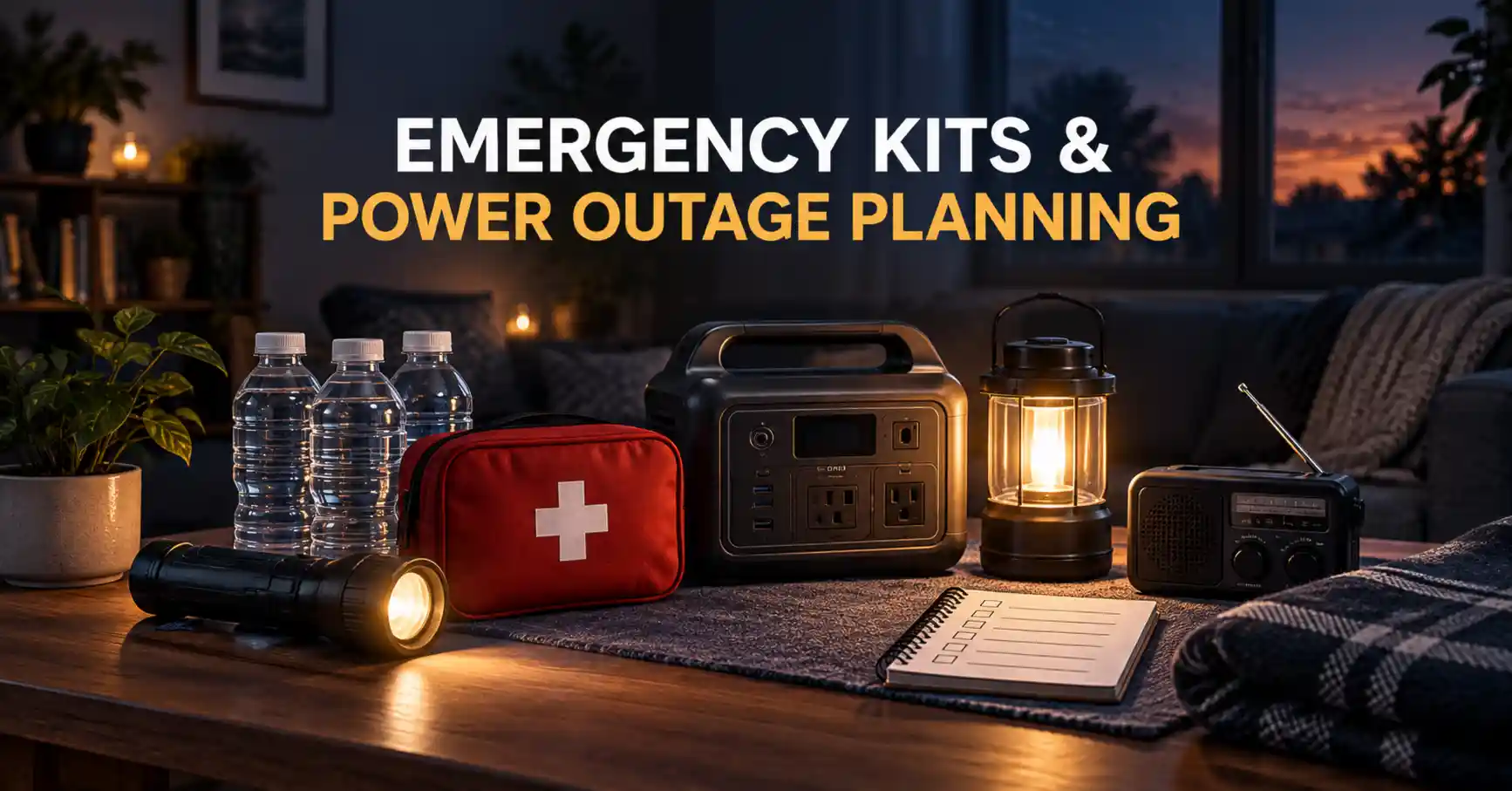
A good emergency kit is only part of power outage preparedness. The stronger plan combines basic supplies, backup lighting, communication, food and water planning, safe backup power, and a clear idea of what your household needs most if the grid goes down.
For most homes, the goal is not to power everything. It is to keep people safe, maintain communication, protect critical food and medications, and support the most important electrical loads until utility power returns or you can relocate.
If refrigeration is one of your priorities, see our guide to keeping a refrigerator running during a power outage. Apartment residents can also review our backup power options for apartments.
Emergency Kit Checklist: Quick Grab List
Start here before an outage:
- Water – at least 1 gallon per person per day for at least 3 days for drinking and sanitation
- At least a 3-day supply of nonperishable food
- Manual can opener if needed
- Flashlights or headlamps and spare batteries
- Battery-powered or hand-crank radio
- First-aid kit
- Prescription medicines and medical supplies
- Phone power banks, charging cables, and device-specific adapters
- Cash, important documents, local maps, and emergency contacts
- Personal hygiene and sanitation supplies
- Pet or service-animal food, water, medications, carriers or leashes
- Household-specific supplies for infants, older adults, disabilities, or medical needs
Also do this before severe weather: charge backup batteries, test smoke and carbon monoxide alarms, review your evacuation plan, and verify the actual wattage of any equipment you expect to power.
Quick Answer: What Should Be in an Emergency Kit for a Power Outage?
Plan for at least three days of basic supplies, then adjust upward for your location, household needs, local hazards, and how quickly outside help may reach you. FEMA emergency-kit guidance calls for at least a three-day supply of water and nonperishable food, including one gallon of water per person per day for drinking and sanitation.
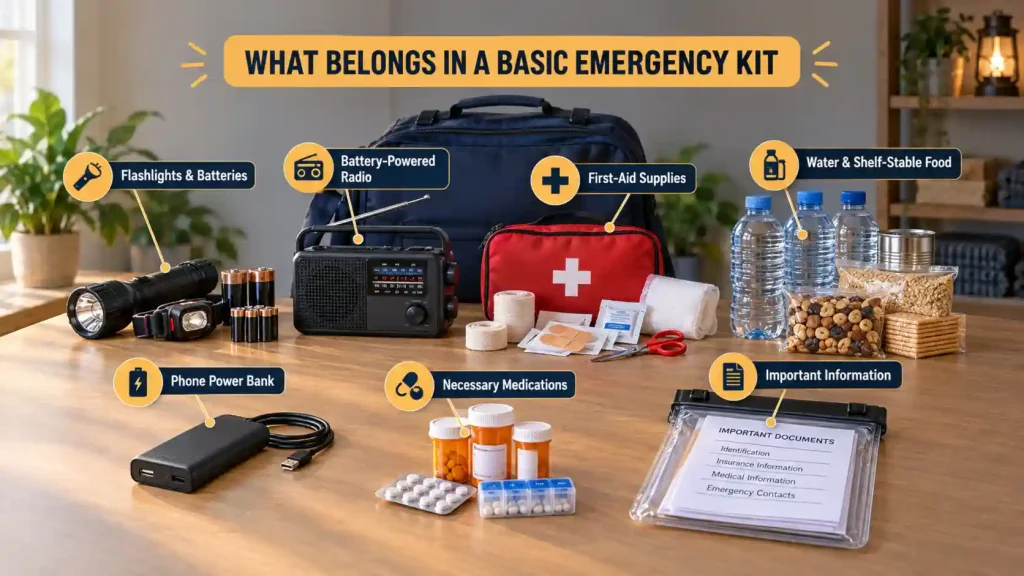
A practical outage kit should also include medications, first-aid supplies, flashlights or headlamps, spare batteries, a battery-powered or hand-crank radio, phone charging options, cash, hygiene supplies, and household-specific items for children, older adults, pets, or anyone with medical or accessibility needs.
FEMA and Ready.gov also recommend building a household communication plan and checking supplies regularly, especially before forecast severe weather. See the official Ready.gov emergency kit guidance and Ready.gov power outage guidance.
Build the Kit Around Your Household, Not a Generic Checklist
Emergency kits work best when they reflect how your household actually lives. A family with an infant has different needs than a household with refrigerated medication, a well pump, a CPAP machine, pets, or limited mobility.
Core emergency supplies
- Water – at least one gallon per person per day for at least three days as a basic starting point
- At least a three-day supply of nonperishable food
- Manual can opener if your food supply includes canned goods
- First-aid kit
- Prescription medications and important medical supplies
- Flashlights, headlamps, or battery lanterns
- Spare batteries in the sizes your equipment uses
- Battery-powered or hand-crank radio
- Phone power banks and charging cables
- Cash in small denominations
- Personal hygiene and sanitation supplies
- Copies of important contact information and documents
- Pet food, water, medications, carriers, and leashes where applicable
For households with assistive devices or caregiving needs, add spare chargers, batteries, transportation contacts, medication lists, and backup plans for equipment that depends on electricity.
Plan by Outage Duration
The table below is an Eco Grid Explorer planning framework, not a prediction of how long any outage will last. Local conditions, weather, utility restoration, medical needs, temperature, and access to supplies can change priorities quickly.
| Outage duration | Main priorities | Power strategy | Planning questions |
|---|---|---|---|
| 0-4 hours | Safety, communication, lighting, refrigerator/freezer door discipline | Use phones and small battery backups conservatively | Is the outage local or widespread? Are there weather, fire, flood, or evacuation warnings? |
| 4-24 hours | Food temperature, medical needs, phone charging, indoor temperature, water access | Prioritize essential loads and use larger backup batteries or a safely operated generator if needed | Can you safely remain home overnight? Do you have enough water, medication, and charging capacity? |
| 1-3 days | Water, food, sanitation, medical continuity, refrigeration, heat/cold safety | Use a daily energy budget and multiple safe charging options where available | Can you replenish fuel, ice, water, medications, or battery charge safely? |
| More than 3 days | Sustained access to safe water, food, medication, temperature control, sanitation, and communication | Long-duration backup becomes a logistics problem as much as an equipment problem | Is relocation safer than continuing at home? |
Plan Your Essential Electrical Loads Before the Outage
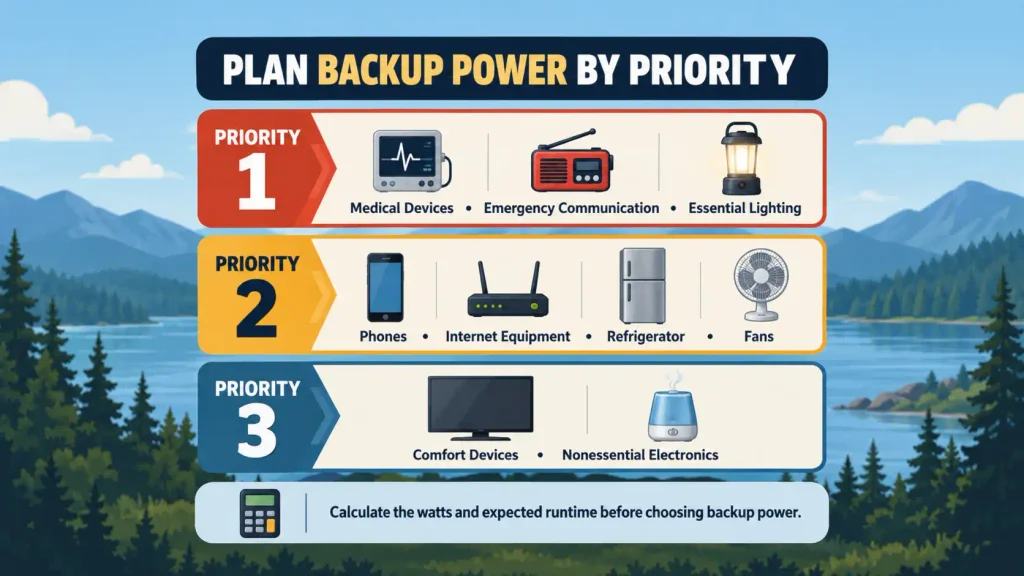
One of the most useful things you can do before an outage is decide what actually needs power. Write down the devices and appliances that matter most, then note their wattage and how long you may need to run them.
Typical priorities may include phones and communication devices, internet equipment, refrigerator or freezer, medical equipment, emergency lighting, fans, laptops, sump pumps, well pumps, or other critical household equipment.
Do not assume a backup battery can run an appliance just because its watt-hour capacity looks large enough. You also need to check continuous inverter output and, for motors and compressors, startup or surge requirements.
Use a simple power budget
Watts x hours of use = watt-hours needed
For example, a device averaging 50 watts for 10 hours would use about 500 watt-hours before accounting for conversion losses and other system overhead. Real runtime will vary by device behavior, inverter efficiency, temperature, battery state of charge, and other factors.
If your main concern is refrigeration, our guide on choosing a power station size for a refrigerator explains capacity and startup wattage in more detail.
Critical Loads Worksheet
Use this worksheet before buying backup equipment. Read the device nameplate, manual, or manufacturer documentation where possible. Startup wattage can be much higher than running wattage for compressors, pumps, and motors.
| Device or load | Running watts | Startup/surge watts | Hours per day | Estimated Wh/day | Priority |
|---|---|---|---|---|---|
| Medical device | _____ | _____ | _____ | _____ | Critical / High / Optional |
| Refrigerator | _____ | _____ | _____ | _____ | Critical / High / Optional |
| Freezer | _____ | _____ | _____ | _____ | Critical / High / Optional |
| Modem/router | _____ | _____ | _____ | _____ | Critical / High / Optional |
| Phones/tablets | _____ | Not usually applicable | _____ | _____ | Critical / High / Optional |
| Lighting | _____ | Not usually applicable | _____ | _____ | Critical / High / Optional |
| Sump/well pump | _____ | _____ | _____ | _____ | Critical / High / Optional |
| Other: _____ | _____ | _____ | _____ | _____ | Critical / High / Optional |
Add the estimated watt-hours for the loads you expect to run in a day, then leave a margin for inverter losses, cycling loads, unexpected use, and battery reserve. Any runtime calculated from this worksheet is an estimate, not a guarantee.
Choose Backup Power by Priority
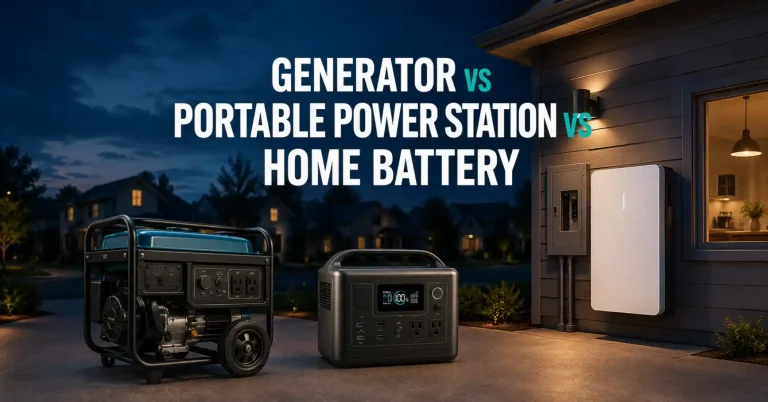
Portable power station
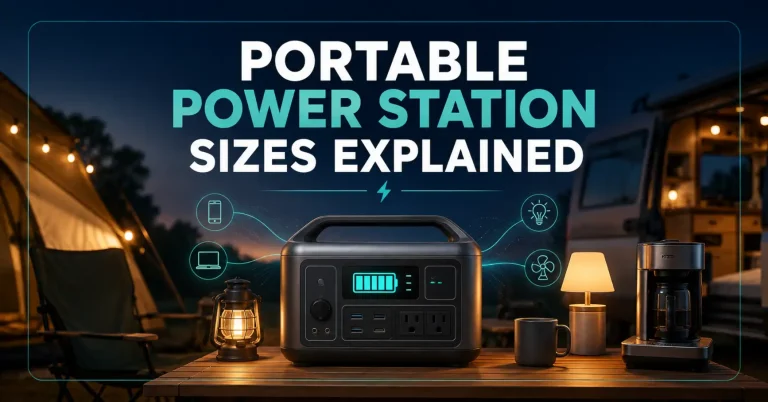
A portable battery power station can run or charge selected devices without producing exhaust at the point of use. It can be practical for phones, lights, routers, laptops, some refrigerators, and other compatible loads. Capacity and inverter output vary widely, so match the unit to the actual equipment you plan to use.
Solar charging
Compatible solar panels can extend battery backup when sunlight is available, but solar recharge rates vary with clouds, temperature, shade, season, panel angle, and the power station’s input limits. Treat advertised solar recharge times as best-case claims unless independent testing shows otherwise.
Portable fuel generator
A fuel generator can support larger or longer-duration loads, but it introduces serious carbon monoxide and fuel-handling hazards. CDC guidance says generators should be used outdoors, more than 20 feet from windows, doors, and vents, and never inside a home, basement, garage, or other enclosed or partially enclosed space. Use a battery-powered or battery-backup carbon monoxide detector when operating a generator.
See the CDC’s power outage safety guidance for current generator and carbon monoxide precautions.
Whole-home battery or standby system
Permanent backup systems can support more circuits and may switch on automatically, but they require more planning, higher cost, and often professional installation.
Special Situations That Need Extra Planning
Well pumps
If your home depends on an electric well pump, a power outage can also become a water outage. Check the pump’s running and startup requirements before assuming a portable power station or generator can run it. Keep emergency drinking water even if you have backup power.
Sump pumps
Sump pumps can be critical during the same storms that cause outages. Motors can have substantial startup demand, so verify both running and surge requirements.
Garage doors
Know how your garage door’s manual release works before an outage, and follow the opener and door manufacturer’s instructions. Do not force or disassemble a door or opener during an emergency.
Electric cooking
If your normal cooking equipment depends on electricity, keep food that can be eaten without cooking. Never bring a charcoal grill, camp stove, or other fuel-burning cooking device indoors to replace an electric range.
Refrigerated medicines
Storage requirements vary by medicine. FDA guidance says to follow the medicine’s labeled storage instructions and, if it has not been kept at the recommended temperature, contact a pharmacist, healthcare provider, or manufacturer to determine whether it can still be used. Have a cooler and ice or frozen gel packs available when appropriate. Do not apply refrigerator food-safety time limits to medication.
Powered medical equipment
Verify the medical device’s actual power requirements and confirm backup compatibility with the device manufacturer. Discuss outage planning with the appropriate healthcare provider when loss of power could create a health risk. Plan for alternate power, transportation, and a place to go if home backup fails. This guide is not medical advice.
Apartments and multifamily buildings
Apartment residents should account for elevators, electronic entry systems, building water pumps, shared garages, and building-specific evacuation procedures. Fuel-burning generators should never be operated in an apartment, on an enclosed balcony, in a hallway, in a shared garage, or anywhere exhaust can enter the building.
Pets and service animals
Keep food, water, medications, carriers or leashes, identification, and a plan for pet-friendly shelter or temporary lodging.
Food and Refrigerator Planning
CDC guidance says food will stay safe up to about 4 hours in an unopened refrigerator, 48 hours in a full freezer, and 24 hours in a half-full freezer. Keep appliance thermometers in both the refrigerator and freezer, and avoid unnecessary door opening.
If the power has been out for 4 hours and a cooler and ice are available, CDC advises moving refrigerated perishable foods to the cooler and keeping them at 40°F or below. Never taste food to decide whether it is safe.
See the CDC’s food safety after an emergency resource.
Medical Devices and Refrigerated Medications Need a Separate Plan
If someone in your household depends on medical equipment that requires electricity, do not rely on a single battery product without a broader emergency plan. Verify the device’s actual power requirements, confirm backup compatibility with the device manufacturer, and discuss outage planning with the appropriate healthcare provider when loss of power could create a health risk.
For medicines requiring refrigeration, follow the product’s storage instructions and seek product-specific advice if recommended temperatures were not maintained. FDA advises contacting a pharmacist, healthcare provider, or manufacturer when needed.
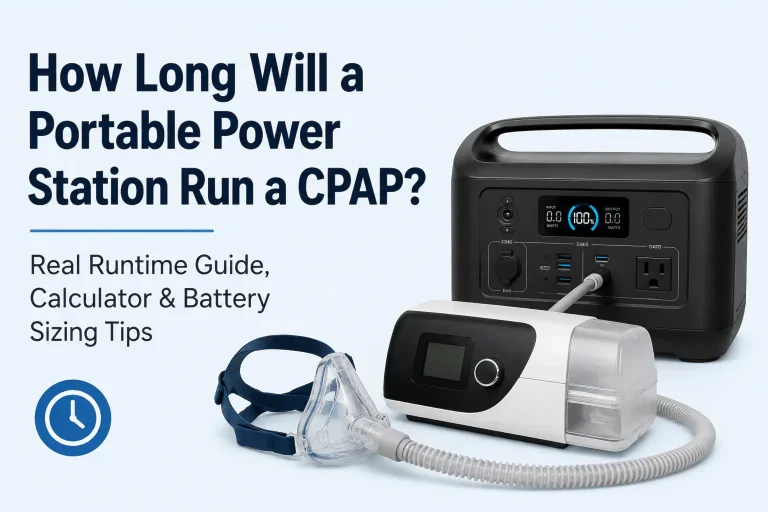
For CPAP users, our CPAP backup power runtime guide explains why device settings, humidifiers, heaters, inverter losses, and battery capacity all affect runtime. Runtime estimates should never be treated as guarantees.
See the FDA’s emergency medication storage guidance.
Communication Planning Matters as Much as Equipment
Before a storm or other outage risk, charge phones, power banks, radios, and backup batteries. Keep a written contact list in case your phone is unavailable or damaged.
- Who checks on children, older adults, neighbors, or pets?
- Where will everyone meet if the home becomes unsafe?
- Which out-of-area contact can family members use as a central point of communication?
- Which local shelters, cooling centers, warming centers, or medical facilities can you reach?
- What transportation options are available if fuel stations or traffic signals are affected?
Prepare for Heat, Cold, and Water Problems
Electrical outages can become dangerous when they overlap with extreme heat or cold. CDC advises seeking shelter with friends or at a community shelter if conditions become too hot or too cold.
Water systems can also be affected during outages. Follow local boil-water or drinking-water advisories and keep safe emergency water available even if you normally rely on a private well.
When Should You Leave the Home During a Power Outage?
Follow evacuation orders and instructions from local emergency officials. Consider relocating or seeking emergency assistance when:
- Indoor heat or cold is becoming unsafe and you cannot maintain a safe environment.
- A medically necessary device cannot be powered reliably or required treatment cannot continue safely.
- Refrigerated medicine cannot be kept within its required storage conditions and you need professional assistance or replacement.
- A carbon monoxide alarm sounds, or anyone develops possible carbon monoxide symptoms such as headache, dizziness, weakness, nausea, vomiting, chest pain, or confusion. Move to fresh air and call 911 or seek emergency help.
- Flooding, fire, structural damage, downed electrical hazards, or official evacuation orders make the home unsafe.
- You no longer have access to safe drinking water, sanitation, necessary medications, or other essential supplies.
Generator, Carbon Monoxide, and Electrical Safety
- Never operate a fuel-burning generator inside a house, garage, basement, shed, camper, or other enclosed or partially enclosed space.
- Keep generators outdoors more than 20 feet from windows, doors, and vents, following CDC guidance and the manufacturer’s instructions.
- Use a battery-powered or battery-backup carbon monoxide detector.
- Do not use charcoal grills or portable camp stoves indoors.
- Do not use a gas oven or range to heat a home.
- Use heavy-duty, outdoor-rated extension cords suitable for the connected load.
- Never use a male-to-male extension cord or attempt to power household wiring by plugging a generator into a wall outlet. CPSC warns that this backfeeding practice creates electrocution and fire hazards.
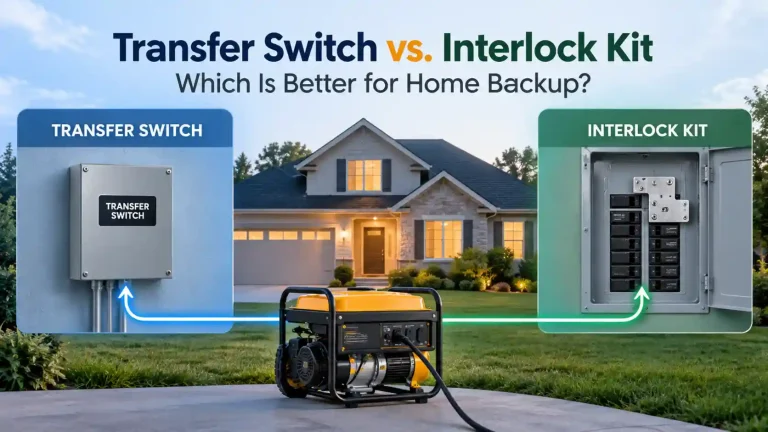
- If a generator is intended to power home circuits, use appropriate transfer equipment and qualified installation.
For additional official guidance, see the CDC’s carbon monoxide safety information and the CPSC’s 2026 warning about male-to-male generator cords and backfeeding.
Printable Household Power Outage Checklist
This section mirrors the downloadable Eco Grid Explorer printable checklist and can also be printed directly from the page.
Important contacts
- Electric utility outage number: ____________________
- Local emergency management: ____________________
- Primary family contact: ____________________
- Out-of-area contact: ____________________
- Doctor / medical provider: ____________________
- Pharmacy: ____________________
- Medical-device manufacturer/support: ____________________
- Nearest shelter / cooling or warming center: ____________________
Backup power
- Critical loads worksheet completed
- Portable power station charged according to manufacturer instructions
- Correct charging cables and adapters located
- Solar equipment checked if part of the plan
- Generator fuel stored safely if applicable
- Safe outdoor generator location identified more than 20 feet from windows, doors, and vents
- Battery-powered or battery-backup CO detector working
- Outdoor-rated extension cords inspected
- No male-to-male generator cords or improvised backfeeding setup
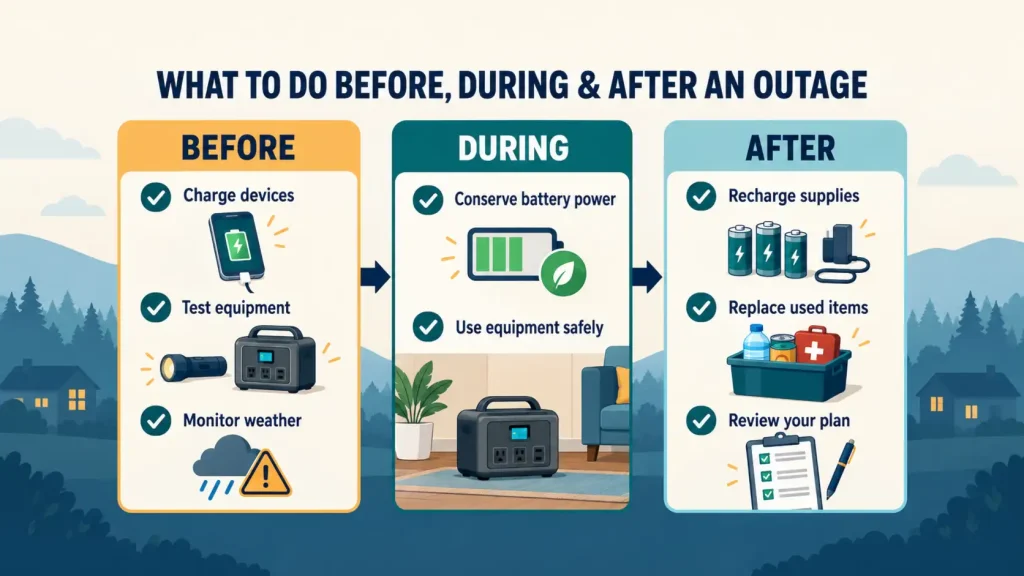
Power Outage Checklist
Before an outage
- Charge phones, power banks, portable power stations, and rechargeable lights.
- Test flashlights, radios, smoke alarms, and carbon monoxide detectors.
- Review prescriptions and medication storage requirements.
- Check emergency water and nonperishable food.
- Freeze water containers or cold packs for refrigerator and freezer protection.
- Confirm the wattage and surge requirements of essential electrical loads.
- Check fuel and safe generator placement if you use a generator.
- Review your family communication, transportation, and evacuation plan.
During an outage
- Keep refrigerator and freezer doors closed.
- Use battery lighting instead of candles when possible.
- Conserve backup battery capacity for priority loads.
- Monitor official weather, utility, and emergency alerts.
- Never operate fuel-burning equipment indoors or in a garage.
- Watch indoor temperature and relocate if conditions become unsafe.
- Follow local water advisories.
After power returns
- Check refrigerated and frozen food before keeping it.
- Check medicines that may have exceeded labeled storage temperatures and seek product-specific guidance when needed.
- Recharge backup batteries, radios, and power banks.
- Replace used emergency supplies.
- Review what worked and what your household was missing.
- Inspect extension cords, chargers, and backup equipment for damage before storing them.
Maintain the Kit and Backup Equipment
Preparedness equipment is easy to forget once the immediate threat passes. As a practical Eco Grid Explorer routine, review the kit at least twice a year and again before major storm seasons or forecast events that commonly cause outages in your area. Always follow manufacturer-specific maintenance and storage instructions.
| Item | What to check |
|---|---|
| Water and food | Expiration or best-by dates, damaged packaging, household quantity, pet supplies |
| Medicines | Current medication list, refill plan, storage instructions, provider/pharmacy contacts |
| Flashlights and radios | Operation, battery condition, spare batteries |
| Power banks and power stations | State of charge and storage procedure according to the manufacturer |
| Solar charging equipment | Cables, adapters, connectors, panel condition, compatibility |
| Generator | Manufacturer-prescribed maintenance, safe fuel storage, cords, outdoor placement plan, CO detection |
| Smoke and CO alarms | Test according to manufacturer instructions and replace batteries/devices when required |
| Critical loads worksheet | Update whenever appliances, medical devices, pumps, or backup equipment change |
| Contacts and evacuation plan | Phone numbers, shelter options, transportation, family meeting locations |
Common Outage Planning Mistakes
Buying backup power before measuring loads
A battery’s capacity alone does not tell you whether it can start or run a particular appliance. Check both energy requirements and inverter output.
Depending on one charging method
A power station is more useful when you have realistic ways to recharge it. Depending on the system, that may include grid charging before the outage, vehicle charging, solar, or generator-assisted charging where supported.
Ignoring fuel, electrical, and carbon monoxide risk
A generator is not an indoor power source, and it should never be improvised into household wiring through a wall outlet. Safe placement, correct cords or transfer equipment, fuel storage, and carbon monoxide detection are essential.
Forgetting non-electric needs
Water, medications, sanitation, food, communication, documents, cash, and evacuation plans can matter more than electronics during a long outage.
FAQs
How many days should an emergency kit cover?
FEMA’s basic guidance calls for at least three days of water and nonperishable food. Depending on local hazards and household needs, keeping more may be prudent.
How much emergency water should I store?
FEMA guidance recommends one gallon of water per person per day for at least three days for drinking and sanitation. Heat, illness, pets, and other needs can increase the amount required.
Should I keep a portable power station charged all the time?
Follow the manufacturer’s storage and charging instructions because recommended storage state of charge varies by product. Before forecast severe weather, make sure the unit is ready for use and that you have the correct cables and adapters.
Can I run a generator in a garage with the door open?
No. CDC guidance says never to use a portable generator inside a home or garage, even if doors and windows are open. Operate it outdoors more than 20 feet from windows, doors, and vents.
Can I plug a generator into a wall outlet to power my house?
No. CPSC warns that using male-to-male cords to backfeed a home’s electrical system creates serious electrocution and fire hazards. Home-circuit generator connections require appropriate transfer equipment and proper installation.
What should I power first during an outage?
Prioritize health and safety. That may include medical devices, communication, lighting, refrigeration for essential food or medication, and equipment needed to keep the home safe.
Is a solar generator enough for a long outage?
Sometimes, but not automatically. Available sunlight, panel size, solar input limits, battery capacity, household demand, and weather all affect whether solar can replace the energy you use each day.
When should I throw out refrigerated food after an outage?
CDC says refrigerated food generally stays safe for up to 4 hours if the refrigerator remains unopened. After 4 hours without power or another cold source, refrigerated perishable foods generally should be discarded. Follow current CDC guidance for specific foods.
Do the same 4-hour rules apply to refrigerated medicine?
No. Medicines have product-specific storage requirements. Follow the medication label and contact a pharmacist, healthcare provider, or manufacturer if required temperatures were not maintained.
My Take
The best outage plan is layered. Start with basic emergency supplies and a communication plan, then add backup power sized for the loads that truly matter. A large battery or generator does not replace food, water, medical planning, safe operating practices, or a backup place to go when conditions become unsafe.
The critical-load worksheet and outage-duration plan are where I would start. Once you know what must remain powered and for how long, it becomes much easier to decide how much battery capacity, generator output, solar charging, or home backup capability you actually need.
Sources
- Ready.gov – Build a Kit
- Ready.gov – Power Outages
- FEMA – How to Build a Kit for Emergencies
- CDC – What to Do to Protect Yourself During a Power Outage
- CDC – Keep Food Safe After a Disaster or Emergency
- CDC – Carbon Monoxide Poisoning Basics
- FDA – Safe Drug Use After a Natural Disaster
- CPSC – 2026 Warning on Male-to-Male Extension Cords