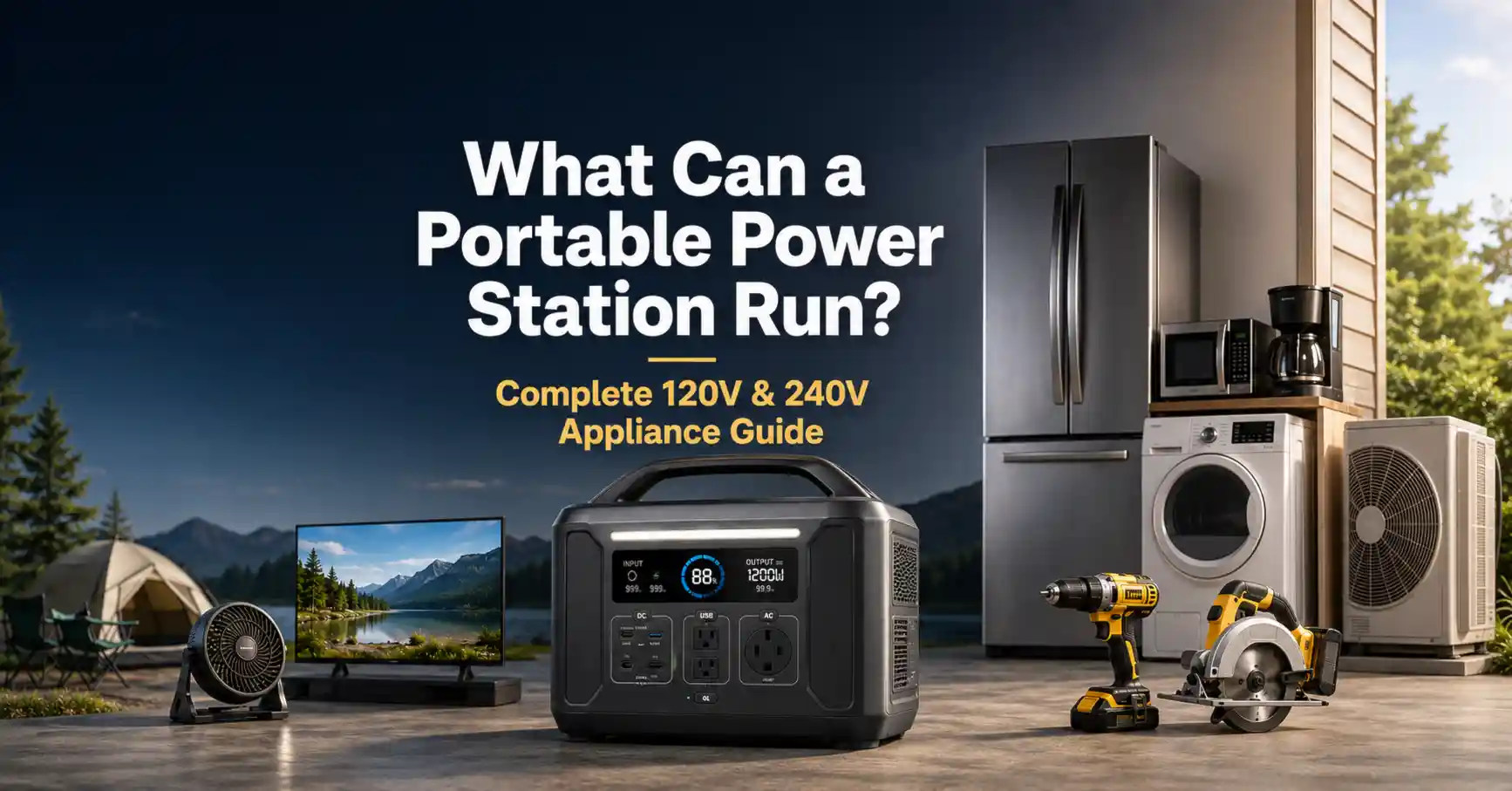
What Can a Portable Power Station Run? Complete 120V & 240V Appliance Guide
If you are trying to figure out what a portable power station can actually run, the numbers can get confusing quickly.
A 1,000-watt power station is not the same thing as a 1,000-watt-hour power station. A refrigerator might use only a few hundred watts while its compressor is running but need substantially more power for a moment when that compressor starts. And even a large battery can disappear surprisingly quickly when I connect a space heater, electric kettle, dryer, or other high-wattage appliance.
I wrote this guide to make those numbers practical.
I’ll show you what common 120V and 240V appliances can run from portable power, how I estimate runtime, how I account for startup surge, how I size solar charging, and where portable power stations stop being practical and larger home-backup systems begin to make more sense.
I base my portable-power guidance on electrical load calculations, appliance manufacturer specifications, government energy information, recognized electrical-safety guidance, and realistic battery limitations rather than relying only on advertised “number of charges” claims.
For the estimates below, I separate battery capacity in watt-hours from inverter output in watts, account for startup loads where they matter, and use conservative runtime assumptions for AC-powered equipment.
Appliance consumption varies considerably by model, age, operating mode, ambient temperature, and settings. Whenever I am sizing backup power for an important appliance, I check the exact nameplate or manufacturer specifications—and, when practical, measure the actual appliance.
Last reviewed: September 2026
Most ordinary plug-in portable power stations in the U.S. are primarily designed for 120V appliances. Larger expandable systems can also provide 240V for equipment such as some well pumps, dryers, electric water heaters, ranges, heat pumps, and home circuits.
A high wattage rating alone does not mean a power station can produce 240V. I always verify voltage support separately.
Quick Answer: What Can a Portable Power Station Run?
A portable power station can run an appliance when three conditions are met:
- The power station provides the voltage the appliance requires.
- The inverter can handle the appliance’s running and startup power.
- The battery contains enough watt-hours for the runtime I need.
Small portable power stations are generally best suited to phones, lights, Wi-Fi equipment, laptops, TVs, fans, cameras, and other electronics.
Mid-size units can add refrigerators, freezers, some microwaves, coffee makers, kitchen appliances, and tools if the inverter is large enough.
Larger 2,000W-plus 120V units can operate many kettles, hair dryers, induction cooktops, power tools, and some room air conditioners, although those loads can use battery capacity very quickly.
Large 120/240V systems move into a different category. Those systems may be capable of selected 240V appliances and home circuits, but they require much more careful load planning.
For examples of systems organized by actual backup use case, I also compare larger options in my Best Solar Generators by Use Case guide.
The Four Numbers I Check Before Powering Any Appliance
1. Voltage: 120V or 240V?
This is the first thing I check.
Typical U.S. residential electrical service provides both 120V and 240V circuits. Standard household receptacles generally supply 120V, while larger loads may use 240V.
A power station that only outputs 120V cannot directly run a 240V appliance, regardless of how large its wattage rating or battery is.
2. Continuous Output in Watts
The inverter’s continuous rating tells me how much electrical power the station can sustainably provide.
If an appliance needs 1,500W continuously and my power station is rated for only 1,000W continuous AC output, it is the wrong power source for that load even if the battery contains several thousand watt-hours.
3. Startup or Surge Output
Motors and compressors can briefly require more power when starting than they consume once running.
This matters particularly with refrigerators, freezers, air conditioners, well pumps, air compressors, and some power tools.
I therefore check both continuous output and the manufacturer’s surge or peak specification.
4. Battery Capacity in Watt-Hours
Battery capacity tells me approximately how long the station can power the load.
A 1,000Wh battery theoretically contains enough energy to supply a 100W load for 10 hours:
1,000Wh ÷ 100W = 10 hours
Real AC runtime is lower because of inverter losses, the station’s own power consumption, battery-management limits, load characteristics, temperature, and other factors.
The 3-Step Compatibility Test I Use
- Voltage: Does the power station provide the 120V or 240V the appliance requires?
- Power: Is the appliance’s running load—and any startup surge—within the inverter’s ratings?
- Energy: Does the battery contain enough watt-hours for the amount of time I want to run it?
If all three work, I then check outlet compatibility and the manufacturer’s operating instructions.
Portable Power Station Runtime & Appliance Calculator
If you already know the specifications of your power station and appliances, you can use my calculator below to estimate whether your setup is compatible and how much battery capacity you may need.
Enter your battery capacity, inverter output, voltage support, and the appliances you want to run. The calculator will check your combined running load, startup surge, 120V or 240V compatibility, estimated energy use, battery coverage, recommended battery capacity, and optional solar recharge requirements.
Tip: For refrigerators, freezers, pumps, air conditioners, and other appliances that cycle or have motors, I recommend using measured energy consumption or the manufacturer’s specifications whenever possible. Generic wattage estimates are useful for planning, but the actual appliance is always the better source.
Watts vs Watt-Hours: The Difference That Matters Most
I think of watts and watt-hours as answering two different questions.
Watts tell me what I can run.
Watt-hours help tell me how long I can run it.
A 2,000W inverter can potentially run a much larger appliance than a 500W inverter.
But if both power stations contain the same 1,000Wh battery, they still have roughly the same amount of stored energy.
A bigger inverter does not automatically mean a bigger battery.
My Portable Power Station Runtime Formula
For quick AC planning, I often use:
Estimated runtime = Battery Wh × 0.85 ÷ Load Watts
The 85% figure is a planning assumption, not a guaranteed efficiency specification for every power station.
Some systems may perform better or worse depending on inverter efficiency, load level, temperature, battery condition, idle consumption, and battery-management behavior.
If I need a dependable runtime for an important application, I test the actual setup rather than treating the formula as a promise.
Complete 120V Appliance Guide
The ranges below are intended for initial planning. Exact consumption can differ dramatically between models.
| Appliance or Device | Rough Planning Range | What I Watch For |
|---|---|---|
| Smartphone charging | 5–30W | Very easy load |
| LED light | 5–20W | Excellent emergency-power load |
| Wi-Fi router/modem | 10–30W | Low continuous consumption |
| Tablet | 10–30W | USB/DC may improve efficiency |
| Laptop | 30–100W+ | High-performance laptops can use more |
| CPAP machine | Highly model/settings dependent | Humidifier and heated tubing can substantially affect consumption |
| LED television | About 50–200W | Screen size and brightness matter |
| Fan | About 30–100W | Generally easy backup load |
| Desktop computer + monitor | 100–500W+ | Gaming/workstation systems can be much higher |
| Mini refrigerator | Often 50–150W while compressor runs | Startup surge and cycling |
| Full-size refrigerator | Often roughly 100–300W while compressor runs | Startup surge and duty cycle |
| Freezer | Often roughly 100–400W while compressor runs | Startup surge and cycling |
| Blender | 300–1,000W+ | Motor startup |
| Coffee maker | 600–1,500W | Heating element |
| Microwave | Often 1,000–1,700W input | Check input wattage, not advertised cooking watts |
| Toaster | 800–1,500W | High but short-duration load |
| Electric kettle | About 1,200–1,800W | High inverter requirement |
| Hair dryer | About 1,000–1,875W | Very high 120V load |
| Space heater | Commonly up to about 1,500W | Drains batteries extremely quickly |
| Portable induction cooktop | Often 1,200–1,800W | High continuous load while heating |
| Power tools | Hundreds to 1,800W+ | Motor surge varies significantly |
| Window air conditioner | Often several hundred to more than 1,000W | Model voltage, compressor surge, and cooling capacity |
These ranges are not substitutes for the appliance nameplate. ENERGY STAR data, for example, shows substantial differences in refrigerator and room-air-conditioner energy consumption depending on size, configuration, and model. I check the exact appliance whenever runtime matters. See ENERGY STAR refrigerator guidance and ENERGY STAR room air conditioner guidance.
What Can a 300Wh Portable Power Station Run?
I think of a roughly 300Wh station primarily as a personal-electronics and light emergency-power unit.
Using my 85% planning assumption gives me around 255Wh of estimated usable AC energy.
This size is useful for phones, tablets, LED lighting, Wi-Fi equipment, laptops, small fans, cameras, radios, and some medical devices after checking their actual requirements.
A steady 50W load works out to approximately 255Wh ÷ 50W = 5.1 hours.
I would not choose this size as my primary refrigerator backup unless testing showed that both startup power and required runtime were comfortably within its capabilities.
What Can a 500Wh Portable Power Station Run?
Around 500Wh gives me considerably more flexibility.
Using the same planning assumption gives about 425Wh of estimated AC energy.
Possible uses include phones and tablets, several LED lights, router/modem, laptops, TV, fans, selected CPAP setups, and some small refrigerators if startup requirements are within the inverter’s limits.
A steady 60W load works out to roughly seven hours in this simplified example.
What Can a 1,000Wh Portable Power Station Run?
The roughly 1kWh class is where I start getting much more useful home-outage flexibility.
At 85% for planning, I have approximately 850Wh of estimated usable AC energy.
Depending on inverter output, that can potentially cover a refrigerator, freezer, internet equipment, lights, TV, fans, laptops, medical equipment, a coffee maker for short periods, a microwave for short periods, and selected power tools.
The important catch is that 1,000Wh of battery does not mean the station has a 1,000W inverter. I always check both specifications.
What Can a 2,000Wh Portable Power Station Run?
Around 2kWh is much more capable for household backup.
At an 85% planning assumption, I have about 1,700Wh of estimated AC energy.
If the station also has a high-output inverter, I may be able to operate combinations such as refrigerator + Wi-Fi + lights, freezer + electronics, microwave for short periods, coffee maker, electric kettle, induction cooktop, power tools, and some 120V room air conditioners.
A 1,500W resistance heater, however, would theoretically consume 1.5kWh every hour it operates. That is why heating is usually one of the first loads I avoid when conserving battery energy.
What Can a 500W, 1,000W, 1,500W, 2,000W, or 3,000W Inverter Run?
| Continuous 120V Output | Examples of Loads It May Support | Common Limitation |
|---|---|---|
| 500W | Phones, laptops, lights, router, TV, fans | Most heating appliances are too large |
| 1,000W | Electronics plus selected refrigerators, freezers and tools | Many microwaves, kettles and heaters exceed it |
| 1,500W | Many refrigerators, coffee makers, tools and some microwaves | A 1,500W appliance leaves essentially no headroom |
| 2,000W | Many microwaves, kettles, induction cooktops, hair dryers and tools | High loads drain batteries rapidly |
| 3,000W | Multiple 120V loads and many demanding appliances | Still does not automatically provide 240V |
I avoid sizing an inverter so tightly that my expected load sits right at its maximum rating.
120V vs 240V: What Is the Difference?
A typical U.S. home is supplied with 120/240V split-phase electrical service.
Most standard receptacles use 120V between one hot conductor and neutral. A 240V circuit uses both hot legs, producing approximately 240V between them.
The U.S. Department of Energy illustrates this standard 120/240V residential arrangement in its U.S. Electricity Industry Primer.
Portable power stations complicate this because many products provide only 120V AC even when they have large batteries and powerful inverters.
A 3,000W 120V power station cannot directly run a 240V appliance simply because the appliance uses less than 3,000W.
The output voltage must also match.
Which Household Appliances Commonly Use 240V?
- Electric clothes dryers
- Electric ranges and ovens
- Electric resistance water heaters
- Heat-pump water heaters
- Central air conditioners
- Heat pumps
- Well pumps
- Large workshop equipment
- Some welders and compressors
- Level 2 EV charging equipment
Not every appliance in these categories is 240V. I always verify the actual nameplate.
240V Appliance Guide
| 240V Load | Example Power Requirement | Portable Battery Reality |
|---|---|---|
| Electric clothes dryer | Many conventional models are roughly 4.8–5.6kW | Requires high 240V output and consumes battery rapidly |
| Electric range | Whole-appliance nameplate ratings can exceed 10kW | Very demanding; using individual elements still requires careful load management |
| Electric tank water heater | 4.5kW heating elements are common | Technically possible on sufficiently large systems but energy intensive |
| Heat-pump water heater | Highly mode/model dependent | Heat-pump mode may use far less than resistance backup, but check exact specifications |
| Central AC / heat pump | Highly model dependent | Compressor startup and total system load can be substantial |
| Well pump | Highly dependent on horsepower, depth and pump design | Startup surge is often the critical limitation |
| Level 2 EV charging | Several kilowatts is common | Possible on specialized systems but generally an inefficient use of limited outage storage |
| Workshop equipment | Model dependent | Check voltage, continuous amps and motor surge |
As a real-world reference point, GE lists many of its 240V electric dryers at approximately 5,000–5,600W, typically on a 30A circuit. See GE’s electric dryer electrical-rating information.
Why 240V Circuit Amps Can Be Misleading
The basic electrical formula is Watts = Volts × Amps.
- 240V × 20A = 4,800W
- 240V × 30A = 7,200W
- 240V × 40A = 9,600W
- 240V × 50A = 12,000W
But those figures describe electrical capacity at that voltage and current. They do not mean an appliance on a 30A breaker continuously consumes 7,200W.
I use the appliance’s actual nameplate rating or measured consumption—not breaker size alone—to estimate load and runtime.
Can a Portable Power Station Run an Electric Dryer?
A normal 120V power station cannot run a standard 240V electric dryer.
A large 240V-capable battery system potentially can if it provides enough continuous power and the correct outlet or approved home connection.
But runtime can be the bigger problem.
A dryer drawing around 5,000W consumes approximately 5kWh for every hour that load is sustained.
Even a 5kWh battery would therefore have limited dryer runtime once system losses and other household loads are considered.
If I am conserving electricity during a blackout, an electric dryer is very low on my priority list.
Can a Portable Power Station Run an Electric Range or Oven?
Only a sufficiently large 240V-capable system.
Full electric ranges can have nameplate ratings well above the output of many portable battery systems.
I also distinguish between running one cooktop element and trying to run an entire range with multiple burners and the oven operating together.
For emergency cooking, I would usually rather use a smaller, controlled appliance that fits comfortably within my power budget.
Can a Portable Power Station Run an Electric Water Heater?
A large 240V-capable battery system may be able to run one, but resistance water heating consumes a great deal of energy.
Many standard electric storage water heaters use 4,500W elements.
4.5kW × 1 hour = 4.5kWh
The thermostat normally cycles the elements, so that is not necessarily the appliance’s hourly average. But the example shows why water heating can rapidly consume a backup battery.
Can a Portable Power Station Run Central Air Conditioning?
Some large 240V systems can support selected central air conditioners or heat pumps, but I would never size the battery from a generic online wattage chart.
I check voltage, rated load, minimum circuit requirements, compressor startup characteristics, blower or air-handler consumption, and other simultaneously operating loads.
Variable-speed equipment can behave very differently from older single-stage compressors.
If HVAC is a primary backup goal, I size the system around the actual equipment.
Can a Portable Power Station Run a Well Pump?
A 240V-capable battery system potentially can, but well pumps are exactly the kind of load where I pay close attention to motor starting requirements.
Pump horsepower, water depth, motor design, pressure system, and electrical configuration all matter.
I would not buy a power station for a well pump without obtaining the pump’s exact electrical specifications first.
Can I Charge an Electric Vehicle From a Portable Power Station?
Technically, some large 240V systems can supply compatible EV charging equipment.
Practically, I rarely consider this a good primary use of a small or medium outage battery because an EV can accept many kilowatt-hours of energy.
Putting several kilowatt-hours into a car can consume most or all of the stored energy I might otherwise use for refrigeration, lighting, communications, and household essentials.
240V Does Not Automatically Mean Whole-Home Backup
A power station may provide a 240V outlet without having enough inverter output or battery capacity to run every circuit in a home.
Likewise, a system marketed for “whole-home backup” still requires load management.
I look at total continuous output, 240V output rating, per-output limits, surge capability, battery capacity, expansion options, home-integration equipment, and which circuits are actually backed up.
My solar generator guide includes examples of expandable 120/240V systems designed for this larger class of backup.
Can a Portable Power Station Run a Refrigerator?
Yes, many can.
The two biggest considerations are compressor startup and total daily energy consumption.
A refrigerator does not normally consume its full running wattage 24 hours a day. Its compressor cycles.
Energy use changes with room temperature, door openings, food temperature, refrigerator size, freezer configuration, age and efficiency, and thermostat settings.
ENERGY STAR notes that refrigerator size and configuration affect energy consumption, and older refrigerators can use more electricity than newer efficient models. See ENERGY STAR’s refrigerator guidance.
When refrigeration is important, I prefer measuring actual energy consumption rather than relying on a generic chart.
Can a Portable Power Station Run a Freezer?
Usually, if the inverter can start the compressor and the battery has enough capacity.
Like a refrigerator, a freezer cycles rather than drawing its compressor wattage continuously.
A chest freezer in a cool basement may behave very differently from an upright freezer in a hot garage.
Can a Portable Power Station Run a Microwave?
Yes, if the inverter is large enough.
The key is checking the microwave’s electrical input power, not just the cooking-output number used in marketing.
A microwave advertised as 1,000W of cooking power can draw substantially more than 1,000W from the wall.
The upside is that microwave use is generally short, so total battery consumption can remain manageable.
Can a Portable Power Station Run a Coffee Maker?
Often, yes.
Many drip coffee makers use roughly 600–1,500W while heating.
The inverter therefore matters, but because the heating period is relatively short, total energy use is much more manageable than running a space heater continuously.
Can a Portable Power Station Run an Electric Kettle?
Yes, if the inverter can handle it.
Many kettles use roughly 1,200–1,800W.
Boiling water for several minutes consumes much less total energy than operating a 1,500W heater for hours.
Can a Portable Power Station Run a Space Heater?
Many larger 120V units can technically operate a common plug-in space heater.
I still consider electric resistance heating one of the least battery-friendly outage loads.
A 1,500W heater consumes 1,500W × 1 hour = 1,500Wh.
That can exhaust a modest portable station very quickly.
Can a Portable Power Station Run a CPAP Machine?
Many can, but I would never size medical-device backup from a generic wattage estimate alone.
CPAP power consumption can change significantly with machine model, pressure, heated humidifier, heated tubing, ambient temperature, and AC vs compatible DC operation.
I check the exact manufacturer specifications and test the full setup before depending on it during an outage.
For medically necessary equipment, I also maintain a broader emergency plan rather than relying on a single consumer battery as the only contingency.
Can a Portable Power Station Run Wi-Fi?
Usually, and this is one of the best uses for a small station.
Modems and routers typically consume relatively little power, so even modest batteries can keep local networking equipment running for many hours.
Backup power cannot guarantee internet service if the provider’s network is also down.
Can a Portable Power Station Run a Computer?
Yes.
Laptops are relatively easy loads. Desktop PCs vary much more, especially gaming PCs and workstations.
If I am backing up a home office, I add the computer, monitor or monitors, router, modem, dock, speakers, and any other equipment operating simultaneously.
Can I Use a Portable Power Station Like a UPS?
Sometimes, but I check the specifications carefully.
Manufacturers use terms such as UPS, EPS, backup mode, and pass-through charging differently.
I check whether simultaneous charging and output are supported, transfer time, output limits while charging, whether connected equipment can tolerate the transfer delay, and whether the manufacturer specifically approves that operating mode.
I do not automatically assume a portable power station behaves exactly like a dedicated computer UPS.
AC vs DC: Why the Connection Can Affect Runtime
The battery inside a portable station stores DC energy.
When I use a normal household AC outlet, the inverter converts that energy to AC, and the conversion consumes some power.
If a device can safely operate from a compatible USB-C or regulated DC output, I may avoid some of those losses.
This can matter for USB-C laptops, phones and tablets, cameras, some routers, selected CPAP equipment, and 12V portable refrigerators.
I always confirm voltage, polarity, connector type, and manufacturer compatibility before using a DC cable.
Why Real Runtime Can Be Lower Than the Calculator
- AC inverter conversion losses
- Inverter idle consumption
- Battery-management reserve
- Cold temperatures
- Very high loads
- Battery age
- Power-factor effects with some equipment
- Cooling fans and internal electronics
- Appliance consumption changing during operation
This is why I treat runtime calculations as planning tools rather than guarantees.
Portable Power Station Runtime Table
Using the 85% planning assumption for a steady AC load:
| Battery Capacity | 50W Load | 100W Load | 500W Load | 1,500W Load |
|---|---|---|---|---|
| 300Wh | ~5.1 hr | ~2.6 hr | ~31 min | ~10 min |
| 500Wh | ~8.5 hr | ~4.3 hr | ~51 min | ~17 min |
| 1,000Wh | ~17 hr | ~8.5 hr | ~1.7 hr | ~34 min |
| 2,000Wh | ~34 hr | ~17 hr | ~3.4 hr | ~1.1 hr |
| 5,000Wh | ~85 hr | ~42.5 hr | ~8.5 hr | ~2.8 hr |
Those calculations assume steady loads. Refrigerators, HVAC equipment, pumps, and thermostatically controlled devices behave differently.
A Real-World 1,024Wh Blackout Example
Imagine I have a 1,024Wh station and want to power a refrigerator drawing about 120W while its compressor operates, a 15W modem/router, and two 8W LED lights.
For illustration only, suppose the refrigerator compressor averages a 40% duty cycle: 120W × 0.40 = 48Wh per hour.
Router: 15Wh per hour.
Lights: 16Wh per hour.
Total estimated average: 48 + 15 + 16 = 79Wh per hour.
Estimated available AC energy using my planning factor: 1,024Wh × 0.85 = 870Wh.
Then: 870Wh ÷ 79W ≈ 11 hours.
I would not assume my refrigerator has a 40% duty cycle without measuring it. This example simply demonstrates the method.
How I Measure an Appliance Instead of Guessing
For plug-in 120V appliances, a plug-in electricity meter can be one of the most useful tools in backup-power planning.
If I am measuring a refrigerator, I prefer recording energy use over several hours—or ideally a full day—rather than looking only at the instantaneous watt reading.
For hardwired or 240V equipment, I use manufacturer specifications or measurements performed with appropriate electrical test equipment by someone qualified to do so. I do not recommend opening panels or improvising measurements on high-voltage circuits.
Portable Power Station Sizing Worksheet
| Appliance | Voltage | Running Watts | Startup Watts | Hours Needed | Energy Needed |
|---|---|---|---|---|---|
| Refrigerator | _____ | _____W | _____W | _____ | _____Wh |
| Freezer | _____ | _____W | _____W | _____ | _____Wh |
| Router/modem | _____ | _____W | N/A | _____ | _____Wh |
| Medical equipment | _____ | _____W | _____ | _____ | _____Wh |
| Lights | _____ | _____W | N/A | _____ | _____Wh |
| Computer | _____ | _____W | _____ | _____ | _____Wh |
| HVAC / pump | _____ | _____W | _____W | _____ | _____Wh |
| Other | _____ | _____W | _____W | _____ | _____Wh |
What Size Portable Power Station Do I Need?
| Use Case | Capacity I Would Start Comparing | Inverter Considerations |
|---|---|---|
| Phones + lights | 200–500Wh | 300–500W is often plenty |
| Router + laptop + lights | 300–700Wh | 500W+ provides useful headroom |
| Camping weekend | 500–1,000Wh | Depends heavily on cooking and refrigeration |
| CPAP + basic overnight essentials | 500–1,000Wh+ | Size from exact medical-device consumption |
| Refrigerator overnight | 1,000Wh class is a useful comparison point | Must handle compressor startup |
| Refrigerator + router + lights + charging | 1,000–2,000Wh+ | Strong surge capability |
| Refrigerator + freezer | 1,500–3,000Wh+ | Allow for overlapping compressor starts |
| Multiple home essentials | 2,000Wh+ or expandable | 2,000W+ often useful |
| 240V well pump / selected home circuits | Large expandable system | Must specifically provide 240V and adequate surge |
| 240V HVAC / large appliances | Large home-backup platform | Requires equipment-specific load calculation |
How Much Battery Reserve Do I Leave?
For emergency planning, I do not like designing a system that only works if I drain it to its theoretical last watt-hour.
I leave operational headroom for longer-than-expected outages, higher appliance consumption, cold weather, battery aging, unexpected phone or device charging, and cloudy weather reducing solar production.
I do not use one universal minimum state-of-charge rule because battery manufacturers have different storage and operating recommendations.
Instead, I size the system so my expected essential load consumes comfortably less than the battery’s theoretical maximum capacity.
How Long Does Solar Take to Recharge a Power Station?
The ideal calculation is simple: Battery Wh ÷ solar watts = ideal charging hours.
For example: 1,000Wh ÷ 200W = 5 hours.
But I would never expect exactly five clock hours in the real world.
Solar output changes with clouds, shade, panel angle, season, latitude, temperature, time of day, charging losses, and the power station’s solar-input limit.
How I Size Solar to Replace My Overnight Use
Suppose I use 700Wh overnight.
If I want to replace that energy the next day, I need the solar array to produce at least 700Wh after real-world losses.
If I assume four useful peak-sun-hours for a simplified example: 700Wh ÷ 4 hours = 175W average required.
But a 175W panel would leave almost no margin for imperfect conditions or conversion losses.
I would therefore choose more solar capacity than the bare mathematical minimum—for example, perhaps 250–300W in this hypothetical scenario, provided the station supports that input.
Actual solar sizing should use local solar-resource conditions, season, panel placement, and the station’s input specifications.
When an Expansion Battery Makes More Sense Than a Larger Inverter
If my station already starts and runs everything I need but does not last long enough, I need more battery capacity, not necessarily a larger inverter.
For example, if my load peaks at only 700W and my existing station has a 2,000W inverter, moving to a 3,000W inverter does little for runtime.
Adding battery capacity could.
I consider more inverter power when I need to run larger or more simultaneous loads. I consider more watt-hours when the loads already work but I need them to operate longer.
Camping and RV Appliance Guide
| Camping/RV Load | Rough Planning Range |
|---|---|
| LED campsite lighting | 5–20W |
| Phone charging | 5–30W |
| Laptop | 30–100W+ |
| 12V compressor fridge/freezer | Often roughly 30–60W while compressor runs |
| Electric blanket | Often 50–150W |
| Portable projector | Roughly 50–300W depending on model |
| Portable fan | 10–100W |
| Satellite internet equipment | Hardware and operating-condition dependent |
Camping is also where DC efficiency can become especially useful. A compatible 12V refrigerator can often avoid keeping the station’s AC inverter running unnecessarily.
How I Prioritize My Battery During a Blackout
- Medical and safety-critical equipment
- Refrigerator and freezer
- Phones, radio, modem and router
- Essential lighting
- Fans or other climate-related essentials
- Necessary computer/work equipment
- Short-duration cooking
- Entertainment
- High-draw heating and convenience loads
Every household is different, but I spend limited watt-hours on safety, food preservation and communications before convenience.
What I Would Avoid Running From a Small Battery
- Space heaters
- Electric dryers
- Electric ovens and ranges
- Resistance water heaters
- Central air conditioning on undersized systems
- Large well pumps without proper surge calculations
- High-power workshop equipment
- EV charging
The issue is not always whether a sufficiently large battery system can run them. It is whether spending that much stored energy on them makes sense during an outage.
Common Portable Power Station Mistakes I Avoid
Confusing Watts With Watt-Hours
Watts determine load capability. Watt-hours describe stored energy.
Ignoring Voltage
A high-output 120V inverter still cannot directly supply a 240V appliance.
Ignoring Startup Surge
A refrigerator may appear to fit comfortably within an inverter rating until its compressor starts.
Using the Circuit Breaker Size as Appliance Consumption
A 30A breaker does not mean the appliance continuously draws 30A.
Assuming Solar Panels Produce Their Rating All Day
A 400W solar array does not supply 400W continuously from sunrise to sunset.
Assuming Battery Capacity Equals Usable AC Energy
Conversion and internal-system losses reduce delivered energy.
Buying More Inverter When I Really Need More Battery
If the appliance already runs correctly, additional watt-hours may be more useful than additional watts.
Trying to Power Everything During an Outage
Load management can often extend backup time more cheaply than buying an enormous battery.
Extension Cord Safety Matters Too
If I use extension cords, I make sure they are appropriately rated for the connected load and environment.
I do not use lightweight indoor cords for high-powered appliances or outdoor conditions.
ESFI advises using extension cords rated for the intended load and warns against overloading them. See ESFI extension-cord safety guidance.
Can I Plug a Portable Power Station Into a Wall Outlet to Power My House?
No—I would never try to energize household wiring by connecting a portable power source to an ordinary wall receptacle.
Improper backfeeding can create severe shock and fire hazards and can endanger utility workers.
Home circuits must be connected using equipment designed for backup-power integration, such as an appropriate transfer system or manufacturer-approved home-integration equipment installed in accordance with applicable electrical requirements.
ESFI explains that transfer equipment isolates utility power from backup power and prevents dangerous backfeeding. See ESFI’s backfeeding guidance.
Battery Power Stations vs Gas Generators Indoors
One major advantage of battery power stations is that they do not have an internal combustion engine producing carbon monoxide.
That makes them fundamentally different from gasoline, propane, or other combustion generators.
A fuel-burning portable generator should never be operated inside a home, garage, or other enclosed or partially enclosed space. ESFI provides detailed portable generator safety guidance.
A battery power station still needs sensible electrical and thermal treatment. I keep vents unobstructed, keep the unit dry, avoid damaged cables, stay within its electrical limits, and follow the manufacturer’s placement and temperature instructions.
LiFePO4 vs NMC Batteries
Two battery terms readers frequently encounter are lithium iron phosphate—LFP or LiFePO4—and nickel-based lithium-ion chemistries such as NMC.
| Characteristic | LFP | NMC-Type Lithium-Ion |
|---|---|---|
| Cycle life | Generally a strength | Varies; often lower than comparable LFP designs |
| Thermal stability | Generally strong | Varies by chemistry and system design |
| Energy density | Generally lower | Generally higher |
| Weight for equivalent energy | Can be heavier | Can have an energy-density advantage |
| Common appeal | Frequent cycling and long service life | Weight and energy density |
U.S. Department of Energy material characterizes LFP as having strong cycle-life and safety attributes but lower energy density than several other lithium-ion chemistries. See the DOE battery chemistry comparison.
I still would not select a power station based on chemistry alone. Battery-management quality, inverter design, warranty, rated cycle life, thermal management, ports and service support all matter.
How Temperature Affects a Portable Power Station
Lithium batteries do not perform identically in every temperature.
Cold conditions can reduce available performance, and many lithium-battery systems restrict or prevent charging below certain battery temperatures.
High heat can also accelerate battery degradation.
I check operating temperature, charging temperature, and storage temperature separately.
How I Store and Maintain a Portable Power Station
I follow the manufacturer’s storage instructions because recommended state of charge and maintenance intervals can differ.
In general, I store the station in a dry location within its specified temperature range, avoid leaving it in a hot vehicle, do not block ventilation openings, inspect cables and connectors periodically, check battery charge during long storage, install firmware updates when recommended, and test important outage equipment before storm season.
Does a More Expensive LFP Power Station Save Money Long Term?
Sometimes—but I compare cost per useful lifetime rather than assuming a more expensive battery is automatically better value.
If I cycle the power station frequently for RV use, off-grid living, time-of-use energy management, or repeated outages, long cycle life can matter much more than it does for a battery that spends almost its entire life in a closet.
I compare purchase price, usable capacity, manufacturer-rated cycle life, warranty, expansion costs, replacement availability, and how frequently I realistically expect to use it.
Printable Emergency Load Plan
| Priority | Device | Voltage | Running W | Surge W | Daily Wh | Essential? |
|---|---|---|---|---|---|---|
| 1 | __________ | __________ | __________ | __________ | __________ | Yes / No |
| 2 | __________ | __________ | __________ | __________ | __________ | Yes / No |
| 3 | __________ | __________ | __________ | __________ | __________ | Yes / No |
| 4 | __________ | __________ | __________ | __________ | __________ | Yes / No |
| 5 | __________ | __________ | __________ | __________ | __________ | Yes / No |
My Portable Power Station Buying Checklist
- Voltage: Do I need only 120V or also 240V?
- Battery capacity: How many watt-hours do my essential loads require?
- Continuous output: Can the inverter support everything I will run simultaneously?
- Surge output: Can it start compressors, pumps and motors?
- Battery chemistry: Does the design fit how frequently I will use it?
- Solar input: Can I replace my daily consumption during an extended outage?
- AC recharge: How quickly can I recharge when utility power returns?
- DC/USB outputs: Can I avoid unnecessary inverter use?
- UPS/EPS behavior: Does it meet the needs of connected equipment?
- Expansion: Can I add capacity later?
- Home integration: Is compatible transfer or panel equipment available if I need circuits backed up?
- Weight: Is it genuinely portable for me?
- Temperature limits: Will it work where I intend to store and use it?
- Warranty: How long is the system supported?
Frequently Asked Questions
Can a portable power station run a refrigerator all night?
Yes, if the inverter can handle compressor startup and the battery has enough usable energy. I measure actual refrigerator consumption when overnight refrigeration is an important requirement.
Can a 1,000W power station run a refrigerator?
Possibly. I need to know the inverter’s continuous and surge output plus the refrigerator’s actual startup requirement. I also need the battery’s watt-hour capacity to determine runtime.
Can a 1,000W power station run a microwave?
Not necessarily. Many microwaves draw more than 1,000W of electrical input. I check the input rating on the appliance.
Can a 2,000W power station run a 1,500W heater?
Potentially, if the station supports that continuous load. The bigger concern may be runtime: a 1,500W heater uses battery energy extremely quickly.
Can a portable power station run a refrigerator and freezer together?
Yes, if the inverter can handle their combined loads and potential overlapping compressor starts. Battery capacity then determines runtime.
Can a portable power station run 240V appliances?
Only if the system specifically provides the required 240V output. A large 120V inverter does not become 240V simply because it has a high wattage rating.
Can a 240V power station run an electric dryer?
Some large systems potentially can, but many conventional electric dryers draw roughly 5kW or more. I need sufficient 240V inverter capacity, the proper connection, and substantial battery storage.
Can a portable power station run central AC?
Some large 240V-capable systems can support selected systems. I size backup around the exact compressor, air handler, starting characteristics and other household loads rather than using a generic AC wattage estimate.
How long will a 1,000Wh power station run a 100W load?
The mathematical ideal is 10 hours. Using my 85% AC planning assumption gives roughly 8.5 hours. Actual runtime can be higher or lower.
Can I leave a portable power station plugged in all the time?
That depends on the model. I check the manufacturer’s instructions regarding pass-through charging, backup modes, long-term charging and battery maintenance.
Is a bigger inverter the same as a bigger battery?
No. More inverter watts let me run larger loads. More battery watt-hours let me run loads longer.
How much solar do I need?
I start with how many watt-hours I expect to consume each day, then size enough solar to replace that energy under realistic local sunlight conditions while staying within the power station’s solar-input specifications.
My Bottom Line
When someone asks me, “What can a portable power station run?” I do not begin with the brand name or the biggest number printed on the front.
I begin with the appliances.
I determine:
- What voltage does the appliance require?
- How many watts does it use while running?
- Does it have a startup surge?
- How many watt-hours will I need over the outage?
For phones, lights, Wi-Fi and laptops, even a small power station can be extremely useful.
Add a refrigerator and I start paying close attention to compressor surge and daily energy consumption.
Add several household appliances and battery capacity becomes increasingly important.
Add a dryer, range, well pump, central HVAC, electric water heater or other 240V load and I move into an entirely different class of power system where voltage, inverter output, surge capacity, battery expansion and safe home integration all matter.
Voltage tells me whether the power is compatible.
Watts tell me whether the station can run the load.
Surge watts tell me whether it can start the load.
Watt-hours tell me how long I can keep it running.
Once I know those four things, portable-power sizing becomes much less confusing.
If you are ready to compare actual backup systems after calculating your loads, see my Best Solar Generators by Use Case guide.