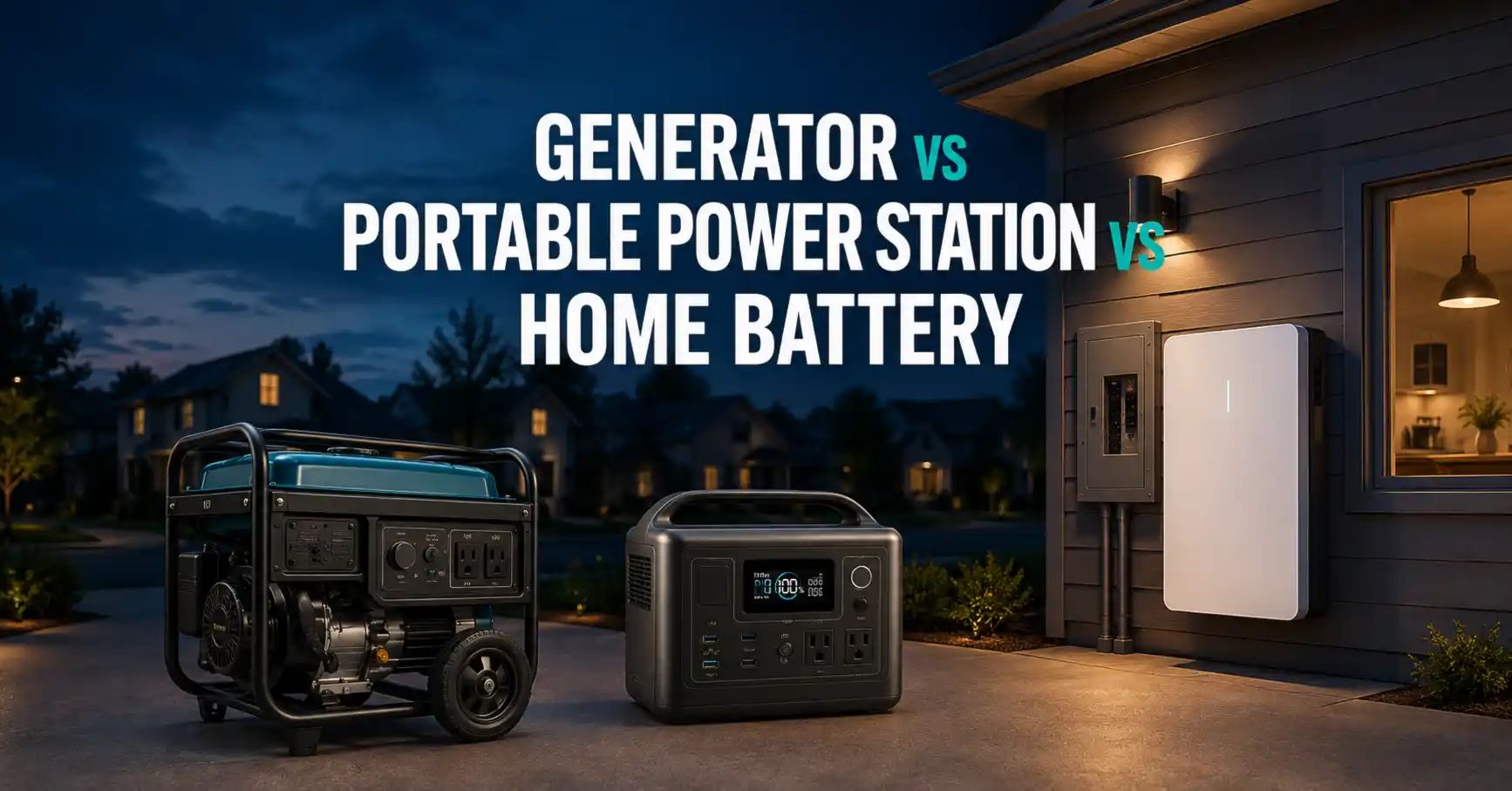
Generator vs Portable Power Station vs Home Battery: Which Backup Power Option Is Best?
When I compare a generator, portable power station, and home battery, I start with one question: what do you actually need to keep running when the grid goes down? The best backup power system is not simply the one with the biggest wattage number. It is the one that matches your loads, outage length, living situation, fuel access, budget, and tolerance for installation or maintenance.
For many households, a portable power station is the easiest place to start because it can run indoors, requires little routine maintenance, and can cover selected essentials. A portable generator makes more sense when long outages and higher energy demands matter more than noise, fuel handling, maintenance, and outdoor-only operation. A home battery is the most integrated option for homeowners who want automatic or near-automatic backup, especially when paired with solar, but it usually requires professional installation and a much larger upfront commitment.
If you are still figuring out your load, I recommend starting with our portable power station appliance guide. If refrigerator backup is the priority, our refrigerator outage guide walks through practical options.
Why You Can Trust This Backup Power Comparison
How I built this guide: This is a research-based comparison, not a hands-on test of one specific generator, portable power station, or home battery. I reviewed current guidance from the U.S. Consumer Product Safety Commission covering generator safety and backfeeding, along with U.S. Department of Energy information about residential solar and battery storage. I use first-person language when sharing my editorial judgment, but I do not present manufacturer claims, estimates, or general examples as personal test results. You can learn more about how Eco Grid Explorer reviews and researches products
Quick Answer: Generator vs Portable Power Station vs Home Battery
| Backup option | Best fit | Main advantage | Main tradeoff |
|---|---|---|---|
| Portable generator | Long outages, larger energy needs, homes with safe outdoor operating space | Can keep producing electricity while fuel is available | Carbon monoxide risk, noise, fuel storage, maintenance, outdoor-only operation |
| Portable power station | Indoor backup for selected essentials, apartments, renters, RVs, short to moderate outages | Quiet, simple, rechargeable battery power with no combustion exhaust during operation | Runtime is limited by stored energy unless you can recharge it |
| Home battery | Homeowners wanting integrated backup, solar storage, and less manual setup during outages | Can be integrated with home circuits and store grid or solar energy for later use | Higher upfront cost and professional installation requirements |
My short version: I would choose a portable power station for simple indoor backup of essentials, a generator for extended outages where fuel and outdoor placement are practical, and a home battery when I wanted the cleanest integrated home solution and was ready for the installation cost.
Which One Should I Choose?
| Your situation | Option I would compare first | Why |
|---|---|---|
| Apartment or rental | Portable power station | No engine exhaust during operation, portable, and usually no permanent installation |
| Short outage with refrigerator, router, lights, and device charging | Portable power station | Simple indoor backup if battery capacity and inverter output are sized correctly |
| Multi-day outage with high daily energy use | Portable generator | Fuel can extend operating time when safely stored and available |
| Homeowner wanting automatic or integrated backup | Home battery | Designed to work with household circuits when properly engineered and installed |
| Home with solar and a goal of using stored solar during outages | Home battery / solar-plus-storage | Properly configured storage can make solar energy available after the sun goes down and during some outages |
| Need for 240V or large motor loads | Depends on system | Verify voltage, continuous output, surge, circuit design, and transfer equipment before choosing |
I would not buy from this table alone. It is a starting point. The next step is to calculate the loads you must run and how much energy those loads need over the expected outage.
What Is the Difference Between the Three?
Portable generator
A portable generator creates electricity while its engine is running. Most consumer models use gasoline, propane, or another fuel. That gives a generator an important advantage during a long outage: you are not limited to a fixed battery capacity. If you can safely store and obtain fuel, you can continue generating electricity.
The downside is that a fuel-burning generator is not an indoor power source. In guidance dated May 27, 2026, the CPSC says portable generators should be operated outdoors only, at least 20 feet from homes and buildings, with exhaust directed away from windows, doors, and vents. I consider that safety requirement a deciding factor, not a small inconvenience.
Portable power station
A portable power station stores electricity in a rechargeable battery and uses an inverter to provide AC power for compatible appliances and electronics. Unlike a fuel generator, it does not burn gasoline or propane while operating. That makes it much easier to use around living spaces, but you still need to follow the manufacturer’s placement, ventilation, charging, temperature, and storage instructions.
The biggest limitation is energy capacity. A 1,000Wh-class battery does not give you unlimited runtime just because its inverter can produce 1,800W or 2,000W. Battery watt-hours and inverter watts answer two different questions: how long can it run? and how much power can it deliver at once? Our guide to what a portable power station can run explains that distinction in more detail.
Home battery
A home battery is a larger energy-storage system connected to the home’s electrical equipment. Depending on the system design, it may back up selected circuits or a much larger share of the house. The U.S. Department of Energy explains that storage can save electricity for later use, including energy produced by solar panels.
I think of a home battery less as a giant portable power station and more as part of the home’s electrical infrastructure. That distinction matters because equipment sizing, transfer behavior, electrical-panel compatibility, permitting, local code, and installation quality all become part of the decision.
Watch: Generator vs. Portable Power Station
🎥 This practical comparison looks at the real-world cost, convenience, and reliability differences between a gas generator and a portable power station. Keep in mind that these are only two of the three options covered in this guide. Continue reading below for my comparison of generators, portable power stations, and permanently installed home battery systems.
Three Example Outage Power Budgets
The examples below are illustrative planning examples, not appliance specifications or guaranteed runtimes. Actual refrigerators, pumps, medical devices, electronics, and other loads can use substantially different amounts of power. I would replace every example number with the appliance nameplate, a reliable meter reading, or manufacturer documentation before buying backup equipment.
| Example plan | Illustrative daily energy budget | What I would consider | Why |
|---|---|---|---|
| Communications and basic lighting | About 0.5-1 kWh/day | Portable power station | Low energy demand can fit a modest battery if the actual loads are verified |
| Refrigerator, router, lights, phones, small electronics | About 1.5-3 kWh/day | Larger portable power station, generator, or home battery | Battery size and recharge strategy start to matter much more |
| Multiple major household loads and pumps | 5+ kWh/day | Generator or professionally designed home battery system | Higher energy use, startup loads, and possible 240V requirements can exceed smaller portable systems |
These ranges are intentionally broad. Refrigerator duty cycle, pump operation, heating or cooling, weather, and household behavior can move the total dramatically. If a load is critical, I would add a reserve rather than size the system to an optimistic minimum.
How to Size Any Backup Power System
Before buying anything, make a simple power budget. I use four numbers:
- Running watts: what each appliance uses while operating.
- Startup or surge watts: the brief higher draw some motors and compressors need.
- Hours of operation: how long you expect each load to run.
- Watt-hours or kilowatt-hours: the total energy you need over time.
A simple energy estimate is watts × hours = watt-hours. If a 100W load ran continuously for 5 hours, the theoretical energy use would be 500Wh. Real appliances may cycle on and off, draw different power at different settings, or have startup surges, so the calculation is only as good as the input assumptions.
For battery systems, remember that nameplate capacity is not the same as guaranteed energy delivered to an AC appliance. Conversion losses, standby consumption, temperature, battery limits, and load behavior all affect runtime. Treat runtime calculations as estimates unless they come from measured testing under conditions that match your use.
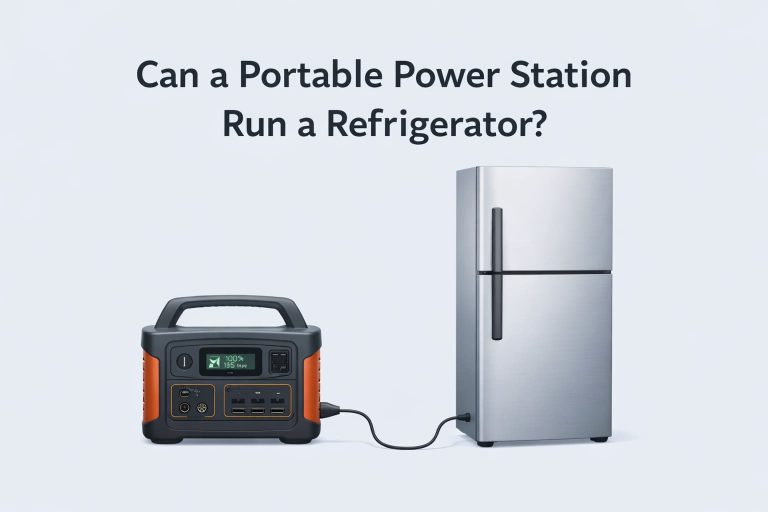
If a refrigerator is your main outage load, our refrigerator power station sizing guide is a useful next step.
What Happens After the Battery Is Empty?
This is one of the most important questions in the entire comparison. I do not want a backup plan that works beautifully for the first evening and has no answer for day two.
| System | How you continue during a longer outage | Important limitation |
|---|---|---|
| Portable generator | Refuel according to the manufacturer’s instructions | Fuel must be safely stored and available, and the generator still requires safe outdoor operation |
| Portable power station | Recharge from AC when grid power returns, or use supported solar, vehicle, alternator, or generator charging options | Charging inputs and compatibility vary by model; solar output depends on conditions |
| Home battery | Recharge from the grid when available and, in compatible solar-plus-storage systems, from solar | Solar does not automatically provide outage power unless the system is specifically configured to do so |
The Department of Energy notes that solar production varies with factors such as time of day, season, clouds, shading, dust, rain, and snow. That is why I would never treat a panel’s rated wattage or an ideal solar recharge time as guaranteed outage performance.
Which Option Handles a Long Power Outage Best?
For a truly long outage, a generator often has the most straightforward endurance advantage because its operating time can be extended by adding fuel. A battery system, whether portable or permanently installed, eventually needs to be recharged.
That does not automatically make the generator the better choice. Fuel availability can become a problem after major storms, generators need maintenance, and safe outdoor placement may not be realistic for every property. A home battery paired with properly configured solar may recharge during an outage when sunlight and system limits allow it, while a portable power station may support solar, vehicle, alternator, or generator recharging depending on the model.
In my view, outage duration should push you toward a recharging strategy, not just a bigger battery. I want to know what happens on day two and day three, not only what happens during the first evening.
Which Is Best for Indoor Backup?
For indoor backup, I would narrow the field quickly to a portable power station or a properly installed home battery. A fuel-burning portable generator should never be treated as an indoor alternative.
This is one reason portable power stations can be especially useful for apartments, renters, and homes where generator placement is difficult. Our backup power guide for apartments goes deeper into indoor-friendly options.
Which Is Best for High-Power Appliances?
This is where people often focus too much on the label and not enough on the electrical numbers. Any backup system has to meet both the appliance’s running power and any startup or surge demand. A generator with high continuous output may handle large loads well, but a sufficiently large portable power station or home battery system may also run demanding equipment if its inverter, wiring, and system design support the load.
For 240V loads such as some well pumps, dryers, ranges, central air systems, and EV charging equipment, compatibility becomes more complicated. Many smaller portable power stations are 120V only. Some larger modular systems support 240V, while permanently installed home batteries can be designed around backed-up home circuits. I always recommend checking the actual appliance nameplate and the backup system’s verified voltage, continuous output, surge capability, and integration requirements before assuming compatibility.
Cost: Compare Ownership Structure, Not Just Purchase Price
I would avoid using one advertised price to declare a winner because prices, installation scope, incentives, and system sizes change. A more useful comparison is what you are paying for over the life of the system.
| Cost area | Portable generator | Portable power station | Home battery |
|---|---|---|---|
| Initial equipment | Generator and needed cords/accessories | Power station plus optional panels or expansion batteries | Battery, inverter/system equipment, controls, and integration hardware |
| Installation | None for extension-cord use; professional work needed for approved home-circuit connection | None for ordinary plug-in use; professional work may be needed for home integration | Professional installation is normally part of the project |
| Ongoing energy | Fuel during operation | Electricity used to recharge; solar equipment may add upfront cost | Grid and/or solar energy used to recharge |
| Maintenance | Engine and fuel-system maintenance according to the manual | Generally lower routine maintenance, with battery storage/charging care | Monitoring and system service as required by installer/manufacturer |
| Replacement considerations | Engine wear and component service | Battery aging and model-specific serviceability | Battery/inverter aging, warranty, and service ecosystem |
For me, the key question is not “Which is cheapest?” It is “Which backup strategy gives me the required power, runtime, safety, and convenience at a total cost I can justify?”
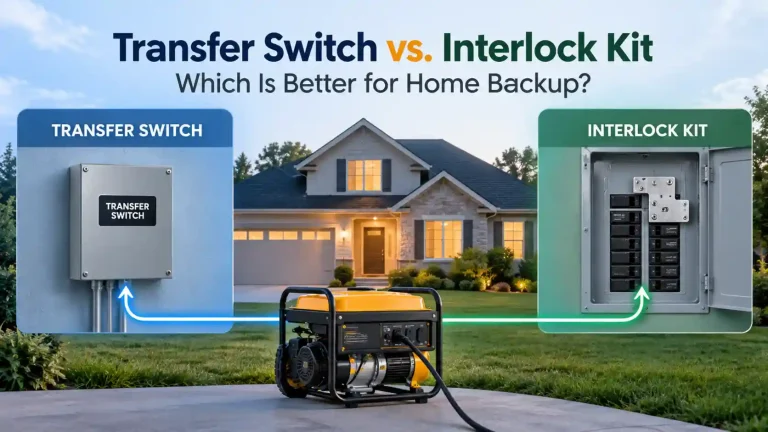
Transfer Switches, Interlocks, and Home Wiring
Plugging individual appliances directly into a correctly rated portable power source is different from energizing household circuits. If a generator, portable battery system, or other source will feed a home’s wiring, I would treat that as an electrical-system project and use equipment and installation methods approved for the specific system and local requirements.
I would never improvise a connection to a receptacle or use a male-to-male cord to backfeed the house. On March 31, 2026, the CPSC warned that male-to-male cords can leave exposed energized prongs and that generator backfeeding can create electrocution and fire hazards.
Depending on the system, proper home integration may involve a transfer switch, approved interlock arrangement, smart panel, dedicated inlet, or manufacturer-specific transfer equipment. The correct choice depends on the equipment, electrical service, local code, and utility requirements, so I would use a qualified electrician or the system’s approved installer rather than assuming one setup fits every home.
Solar During an Outage: A Common Misunderstanding
Rooftop solar does not automatically mean your house will have power when the grid fails. The Department of Energy explains that most ordinary grid-tied residential solar systems are designed to shut down during an outage for safety. Outage operation requires a system specifically designed for it, which may include a compatible inverter, controls, and battery storage.
That detail matters when comparing a home battery with a generator. Solar-plus-storage can be a strong resilience option, but I would verify exactly which circuits can operate during an outage, how the system starts and transfers, how much solar can charge the battery, and what happens when the battery reaches its reserve limit.
Can a Hybrid Backup Strategy Be Better?
Sometimes I would rather build resilience in layers than force one technology to do everything. A battery can cover quiet overnight or short-duration loads, while a separate recharge source can extend endurance during a prolonged outage.
Examples include a portable power station that supports charging from compatible solar panels, or a battery system that can be recharged from an approved generator connection where the manufacturer and system design support it. I would verify every charging input, voltage/current limit, grounding requirement, connector, transfer method, and operating instruction before combining systems. I would not assume two products are compatible simply because a cable can physically connect them.
Noise, Maintenance, and Everyday Convenience
| Factor | Generator | Portable power station | Home battery |
|---|---|---|---|
| Noise during use | Engine noise | Usually quiet except for cooling fans | Usually quiet except for cooling or system equipment |
| Fuel handling | Yes | No combustion fuel during operation | No combustion fuel during operation |
| Routine owner maintenance | More involved | Generally low | Generally low, but system service may require a professional |
| Manual setup during outage | Usually yes for portable units | Usually yes unless integrated with approved transfer equipment | Often designed for integrated transfer, depending on system |
| Portability | Portable, but often heavy | Designed to be movable | Fixed installation |
Readiness and maintenance I would plan for
- Portable generator: follow the owner’s manual for fuel storage, oil, maintenance intervals, exercise/testing, battery care if equipped, and long-term storage.
- Portable power station: periodically check state of charge, storage temperature, cables, charging inputs, firmware/app status when applicable, and the manufacturer’s long-term storage instructions.
- Home battery: monitor system alerts, keep installer/manufacturer contact information available, understand reserve settings, and follow the service schedule for the installed system.
Convenience is the area where I see the biggest lifestyle difference. A generator asks more of the owner during an outage. A portable power station is easier to move and deploy, but you still decide what to plug in and when to recharge. A home battery is built around the idea of being part of the house, which can reduce hands-on setup once it is properly installed and configured.
Who Should Skip Each Option?
I would skip a portable generator if…
- You do not have a safe outdoor operating location that follows current safety guidance and manufacturer instructions.
- You cannot safely store or obtain the required fuel.
- Noise, maintenance, or manual setup would make you unlikely to use or maintain it correctly.
- You are looking for an indoor backup source.
I would skip a portable power station if…
- Your required loads exceed the unit’s verified voltage, continuous output, surge capability, or stored energy.
- You expect multi-day high energy use but have no realistic recharge strategy.
- You need permanent whole-home integration that the product and installation do not support.
I would skip a home battery if…
- You only need a small amount of emergency energy and the installed-system cost does not make sense for your broader goals.
- You rent or cannot make the required electrical changes.
- The proposed system cannot actually support your critical loads, required surge, or desired outage duration.
- You are assuming solar-plus-storage will provide unlimited outage energy without checking system limits and available sunlight.
Safety Differences Matter More Than Marketing
Generator safety deserves special attention. Current CPSC guidance dated May 27, 2026 says portable generators should be used outdoors only, at least 20 feet from the home or building, with exhaust directed away from openings. The agency also recommends working carbon monoxide alarms in the home.
Never use a male-to-male extension cord to feed generator power into household wiring. On March 31, 2026, the CPSC warned that these cords can energize exposed prongs and that using them for generator backfeeding can create electrocution and fire hazards.
Battery systems have different risks. They avoid combustion exhaust during normal battery operation, but they still contain high-energy electrical equipment. I would follow the manufacturer’s charging, temperature, clearance, and storage instructions for portable units, and I would use qualified professionals for permanently installed battery systems, transfer equipment, and electrical-panel work.
Outage Readiness Checklist
- List the appliances and circuits that truly need backup power.
- Record running watts and startup/surge requirements from labels, manuals, or reliable measurements.
- Estimate daily watt-hours or kilowatt-hours and add a reasonable reserve.
- Charge portable batteries before severe weather when practical.
- Test smoke and carbon monoxide alarms and replace batteries as needed.
- Review generator placement and exhaust direction before an emergency.
- Store fuel only in approved containers and follow local requirements and the generator manufacturer’s instructions.
- Inspect extension cords and use cords rated for the intended load and environment.
- Confirm solar panel voltage, current, connector, and input limits before relying on solar charging.
- Know how your transfer equipment or home battery behaves when grid power fails.
- Keep manuals, installer information, charging cables, and approved accessories accessible.
- Test the backup plan before you need it, using non-critical loads first.
Questions I Would Answer Before Buying
- What absolutely has to stay powered?
- How many hours or days am I planning for?
- What is my largest running load?
- What is my largest startup or surge load?
- Do I need 120V only, or do I have critical 240V equipment?
- Can I safely operate a generator outdoors at the required distance from the home?
- Where will fuel come from during an extended outage?
- How will a battery recharge after the first day?
- Do I rent or own, and can I make electrical modifications?
- Do I want manual backup or automatic/integrated transfer?
- If I have solar, is the system actually configured to operate when the grid is down?
- Who will service the system if something fails?
What I Would Choose by Situation
- Apartment or condo: I would usually start with a portable power station because generator exhaust and placement make fuel generators impractical or prohibited in many multi-unit settings.
- Short outages with a refrigerator, router, lights, and device charging: I would lean toward a portable power station sized from actual wattage and runtime needs.
- Long storm outages with room for safe outdoor operation: I would seriously consider a generator, especially if I needed more continuous energy than a practical battery could provide.
- Homeowner with solar who wants integrated backup: I would compare home batteries first, especially if storing daytime solar for evening or outage use is part of the goal.
- Critical home circuits with minimal manual setup: I would investigate a professionally installed home battery or another properly engineered standby system rather than relying only on extension cords.
- Best resilience: In some homes, I would consider a layered approach – for example, a battery system for quiet immediate backup plus another safe, manufacturer-supported way to recharge during a prolonged outage.
Common Mistakes I Would Avoid
- Buying based only on peak watts without calculating energy use over time.
- Assuming a solar panel automatically means unlimited outage runtime.
- Planning to run a portable generator in a garage, porch, carport, shed, or other unsafe location.
- Ignoring startup surge for refrigerators, pumps, compressors, and other motor loads.
- Assuming every portable power station supports 240V home appliances.
- Assuming rooftop solar will automatically power the house during a grid outage without the required system design and equipment.
- Connecting a generator to home wiring with improvised cords or unsafe backfeeding.
- Buying a battery with enough inverter watts but not enough watt-hours.
- Buying enough battery capacity but not enough inverter output for startup loads.
- Waiting for an outage before testing the backup plan.
Generator vs Portable Power Station vs Home Battery FAQs
Is a portable power station the same as a generator?
No. A portable power station stores previously generated electricity in a battery. A fuel generator produces electricity while its engine is running. The terms are sometimes blurred in marketing, especially with the phrase “solar generator,” but the underlying energy source is different.
Can a portable power station replace a generator?
For selected loads and shorter outages, often yes. For long outages or very high energy demand, a generator may be easier to keep running because it can be refueled. The answer depends on battery capacity, inverter output, load, and recharge options.
Can a home battery run an entire house?
Some systems can support large portions of a home, while others are designed around selected critical circuits. Whole-home capability depends on inverter output, battery capacity, surge requirements, 120V/240V support, electrical-panel design, and the loads you expect to run. I would not assume “whole-home” from battery capacity alone.
Can I use a portable generator indoors if the door is open?
No. The CPSC warns never to use a portable generator inside a home, garage, basement, crawlspace, shed, or other enclosed area, even if doors or windows are open. Current guidance is to operate it outdoors only, at least 20 feet from homes and buildings, with exhaust directed away from openings.
Will rooftop solar work during a blackout?
Not necessarily. The Department of Energy explains that ordinary grid-tied solar systems generally shut down when grid power fails. Outage operation requires a system specifically designed for it, which may include a compatible inverter, controls, and storage.
Is a home battery always cheaper to run than a generator?
There is no universal answer. A fair comparison has to include equipment cost, installation, electricity or fuel, maintenance, expected usage, battery or engine aging, local rates, incentives, and how often outages occur. I would compare total ownership for the specific household rather than assume one technology is always cheaper.
My Take
I do not think there is one universal winner in the generator vs portable power station vs home battery comparison. I see them as three different levels of backup strategy.
A portable power station is the most approachable option for many people because it is quiet, flexible, and easy to use for selected essentials. A generator earns its place when outage duration and energy demand are the bigger concern and the property supports safe outdoor operation. A home battery is the option I would look at when I wanted backup power to feel like part of the house rather than a piece of emergency equipment I pull out after the lights go off.
The best decision comes from sizing the load first. Once I know the watts, watt-hours, outage duration, recharge plan, installation needs, and safety constraints, the right technology usually becomes much clearer.
Sources
- U.S. Consumer Product Safety Commission – Generator, Carbon Monoxide and Fire Hazards – May 27, 2026
- U.S. Consumer Product Safety Commission – Male-to-Male Extension Cord and Backfeeding Warning – March 31, 2026
- U.S. Department of Energy – Solar and Resilience Basics
- U.S. Department of Energy – Homeowner’s Guide to Solar
- U.S. Department of Energy – Solar Energy and Storage Basics