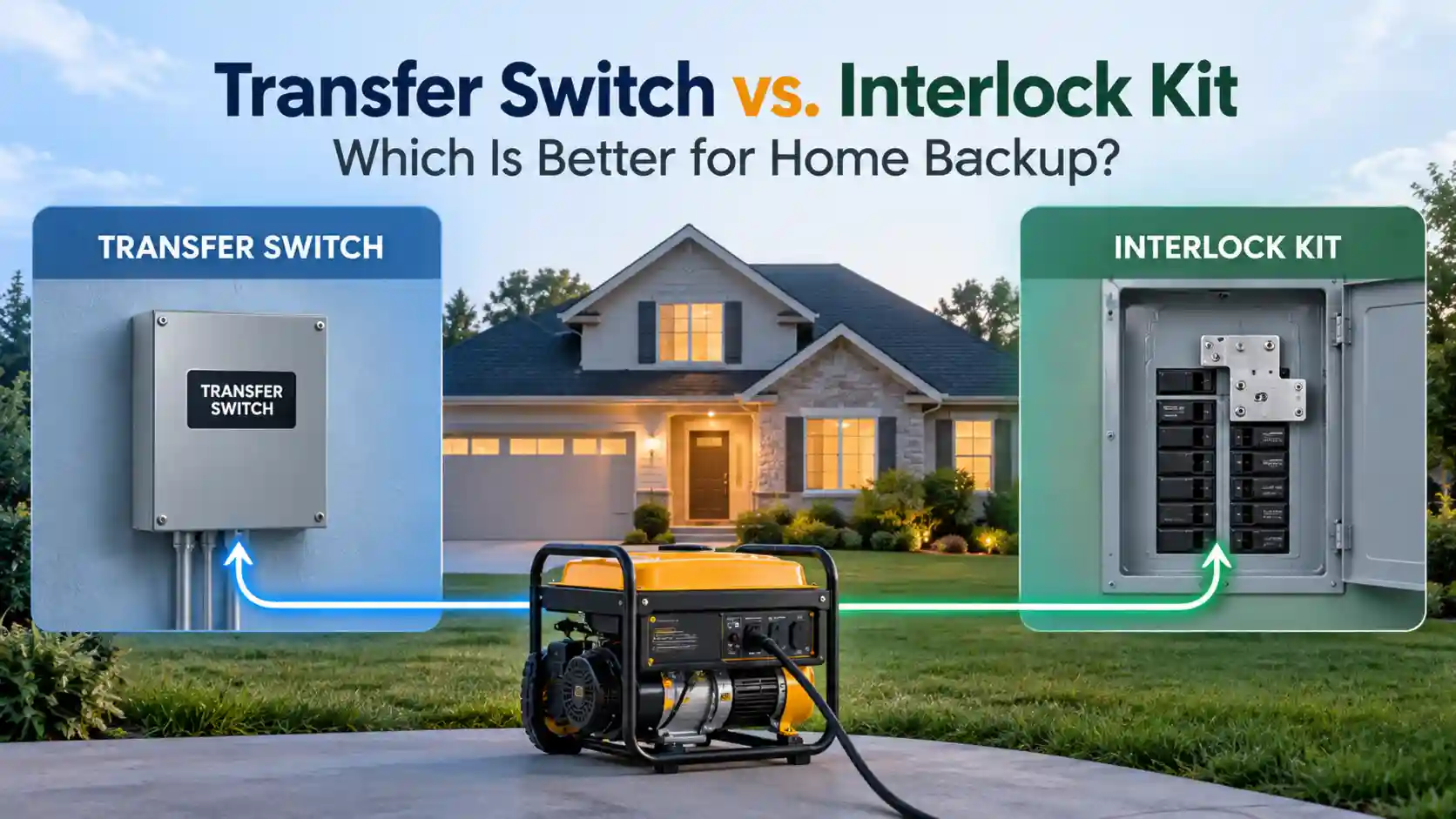
Generator Transfer Switch vs. Interlock Kit: Which Is Better for Home Backup?
Introduction
Quick answer: For many homeowners using a portable generator, either a properly installed manual transfer switch or a panel-specific generator interlock can provide a safe way to connect backup power to selected home circuits. A manual transfer switch is often easier to operate because the backed-up circuits are defined in advance. An interlock kit can give you more flexibility because it can make generator power available to circuits in the main panel, but you still have to manage loads carefully and stay within the generator’s actual capacity.
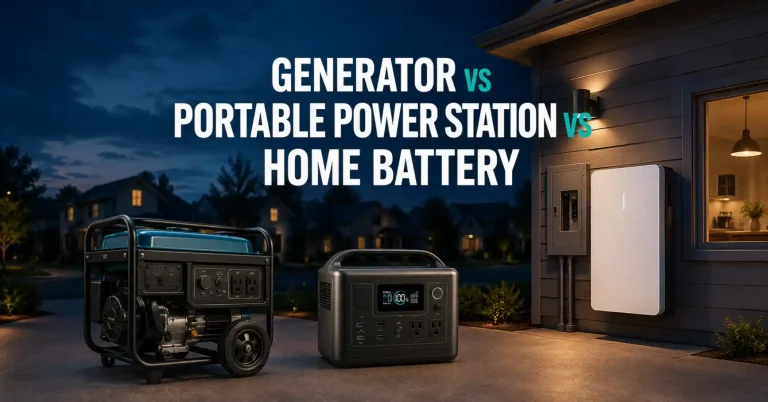
If you are still choosing between a fuel-powered generator, battery power station, or home battery, start with our generator vs. portable power station vs. home battery comparison. This guide focuses on the next question: how a portable generator can be connected to a home’s electrical system without dangerous backfeeding.
Important safety note: This is not a DIY wiring guide. Transfer switches, interlocks, generator inlets, breakers, neutral and grounding arrangements, service equipment, and panel modifications can involve lethal voltage and code requirements. The safest recommendation is professional installation by a qualified electrician, with permits and inspection where required. Never connect a portable generator to household wiring through a standard wall outlet, dryer outlet, range outlet, or a male-to-male “suicide cord.” The U.S. Consumer Product Safety Commission warns that male-to-male cords can create electrocution, fire, and generator-backfeeding hazards.
🔎 Why You Can Trust This Guide
Eco Grid Explorer creates practical, carefully researched guidance using manufacturer documentation, recognized safety information, technical references, and real-world user experiences. We verify important specifications and safety details whenever possible and clearly distinguish documented facts from our own recommendations.
Our goal is to help you make informed decisions about backup power, portable power stations, solar generators, and outage preparedness—not simply promote products.
Transfer Switch vs. Interlock Kit at a Glance
| Feature | Manual Transfer Switch | Generator Interlock Kit |
|---|---|---|
| How it separates utility and generator power | Transfer equipment selects the normal source or generator source for the connected load(s) | A mechanical interlock prevents the utility main breaker and generator breaker from being on at the same time |
| Portable-generator use | Common | Common when a compatible, approved kit exists for the panel |
| Circuits available | Often a defined group of essential circuits, although whole-panel manual transfer equipment also exists | Potentially many circuits already in the panel, subject to generator capacity and load management |
| Ease during an outage | Usually simpler because emergency circuits are predetermined | Flexible, but the homeowner must know which loads can safely run together |
| Panel compatibility | Depends on the transfer equipment and service design | Highly panel-specific – the interlock must match the exact panel/load-center configuration and be acceptable for that use |
| Approximate installed cost | Often about $400-$1,300 for a manual transfer-switch installation, with complex jobs costing more | Often about $400-$850 including common materials and labor |
| Best fit | Homeowners who want a clearly defined essential-load setup and straightforward operation | Homeowners who want more circuit-selection flexibility and have a compatible panel |
These are broad U.S. planning ranges checked in September 2026, not quotes. Panel condition, inlet location, cable routing, amperage, permits, labor rates, and required upgrades can change the total significantly.
What Is a Generator Transfer Switch?
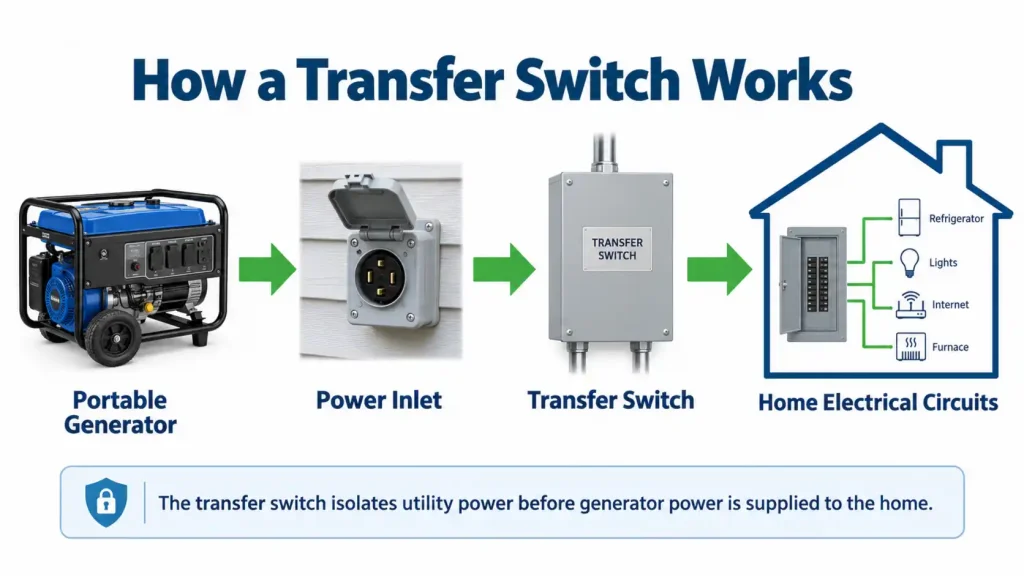
A generator transfer switch is equipment that transfers a load between normal utility power and an alternate source such as a generator. Its core safety job is source isolation: a typical portable-generator system should not be able to connect the utility and generator source to the home at the same time.
For portable generators, a manual transfer switch is a common choice. Depending on the product, it may feed a few essential circuits, a dedicated emergency-load panel, a single large load such as a well pump, or a broader group of circuits. Generac currently sells portable-generator transfer equipment ranging from small 1-2 circuit units to whole-panel manual transfer switches.
A fixed-circuit transfer switch can make outage operation easier because the emergency circuits are selected in advance. That may include a refrigerator, freezer, furnace blower, sump pump, selected lighting, internet equipment, or a well pump if the generator and transfer equipment are properly sized for it.
Manual vs. Automatic Transfer Switches
A manual transfer switch requires a person to transfer the load between utility power and generator power. That is a natural fit for many portable generators because someone already has to place the generator outdoors safely, connect the approved generator cord, start the generator, and manage fuel and loads.
An automatic transfer switch (ATS) detects loss of normal power and transfers the load automatically when the standby source is ready. Automatic transfer switches are much more commonly associated with permanently installed standby generators. Some specific manual transfer products can be upgraded as part of a compatible standby-generator system, but an ATS should not be treated as a generic add-on for any portable generator.
What Is a Generator Interlock Kit?
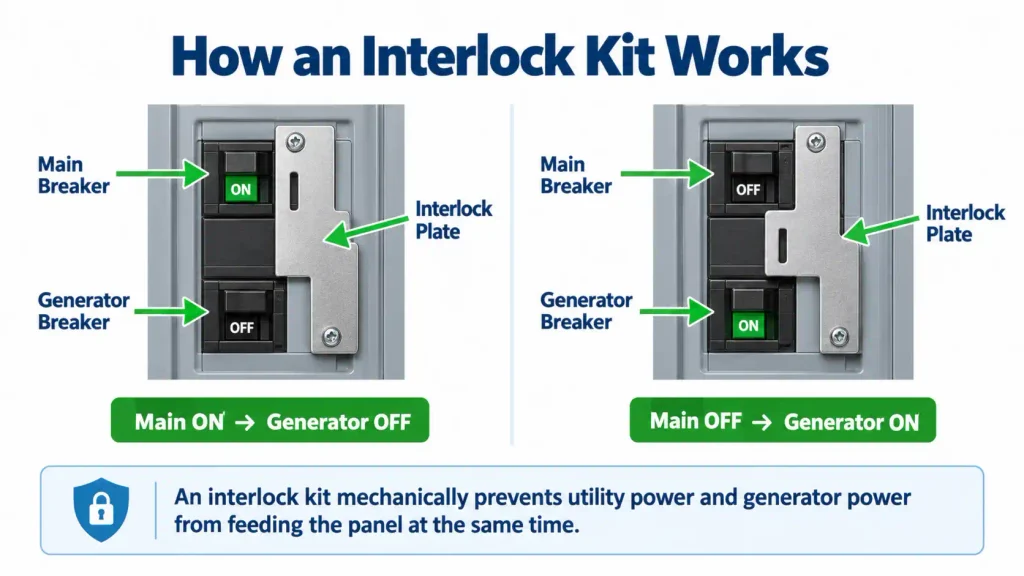
A generator interlock kit is a mechanical device installed at the electrical panel that prevents the main utility breaker and the generator breaker from being switched on at the same time. With one source on, the other source is physically blocked.
Schneider Electric describes its Square D interlocks as sliding mechanical devices that allow either the utility main breaker or generator breaker to be on, but not both. That is the basic concept behind a correctly matched interlock.
The practical advantage is circuit flexibility. In many interlock installations, generator power is made available to the panel bus and the homeowner can choose which branch circuits to energize, rather than being limited to a small fixed list.
That flexibility does not increase generator output. A 7,500-running-watt generator is still a 7,500-running-watt generator whether it feeds a transfer switch or an interlocked panel.
How Both Systems Prevent Utility and Generator Power From Feeding Together
The current 2026 National Electrical Code includes requirements for optional standby systems that call for interconnection, interlocking, or transfer equipment that prevents inadvertent interconnection of power sources. The exact NEC edition adopted where you live may be older, and local amendments can add requirements, so the local authority having jurisdiction has the final word.
A transfer switch provides source separation inside the transfer equipment. A correctly installed interlock provides source separation mechanically at the panel by preventing simultaneous operation of the utility main and generator breaker.
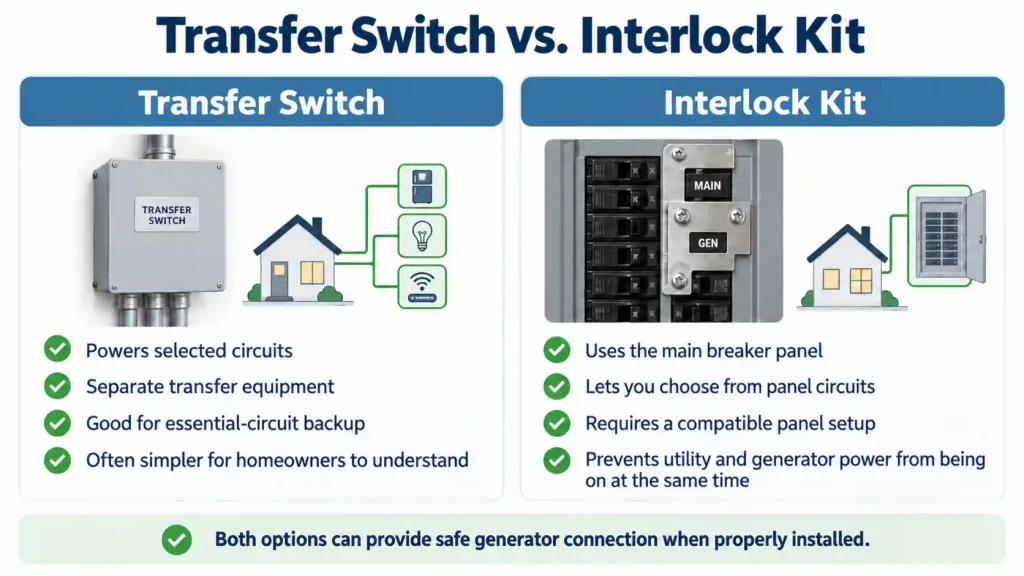
🎬 Watch: This video gives a helpful visual comparison of a generator transfer switch and interlock kit, including how each setup connects to a home electrical system.
Why Backfeeding a Generator Is Dangerous
Generator backfeeding occurs when a generator is connected in a way that can energize home wiring – and potentially utility wiring – without proper source isolation. OSHA warns that a generator connected directly to a structure without properly installed transfer equipment can energize utility wiring and expose utility workers and others to electrocution.
Improvised connections are also dangerous to the homeowner. They can create energized exposed plug blades, fire hazards, incorrect overcurrent protection, and unpredictable current paths.
On March 31, 2026, CPSC again warned consumers to stop using male-to-male extension cords. CPSC specifically identified generator backfeeding as an electrocution and fire hazard.
Never plug a generator into a dryer outlet, range outlet, standard wall receptacle, or other household receptacle to “power the house backward.” Never use a male-to-male cord.
Before You Buy Anything: Gather These Details
One of the easiest ways to waste money is to buy an interlock, inlet, or generator cord before anyone has verified that it matches the house and generator. Before asking for quotes, gather:
- The generator manufacturer and exact model number.
- The generator’s running watts, surge/start watts, and whether it provides 120V only or 120/240V output.
- The generator receptacle type and rated amperage.
- The electrical-panel manufacturer, model/series, main-breaker arrangement, and available breaker spaces.
- The location of the home’s main service disconnect, including whether it is in the same panel or outside near the meter.
- A list of the loads you consider essential during an outage.
- Which essential loads are 240V, such as many well pumps, central air-conditioning systems, electric water heaters, dryers, ranges, or some heat pumps.
- Known running and startup requirements for pumps, compressors, furnaces, refrigerators, freezers, and other motor loads.
Bring that information to the electrician. It helps turn the conversation from “Can I add an interlock?” into the more useful question: “What transfer method is compatible with this generator, this service, and these loads?”
Will My Generator Work With an Interlock or Transfer Switch?
Compatibility is about more than wattage. The generator’s voltage output, receptacles, neutral configuration, and overcurrent protection all matter.
120V-Only vs. 120/240V Generators
Many smaller portable generators provide 120V only. Others provide 120/240V split-phase output through a compatible receptacle. A typical interlock arrangement that energizes both legs of a standard 120/240V residential panel generally requires a generator and connection system designed to provide 120/240V split-phase power.
A 120V-only generator cannot supply normal 240V household loads such as many well pumps. It may still be usable for selected 120V circuits through transfer equipment specifically designed and approved for that application, but this requires an electrician’s evaluation. Do not bridge or tie panel legs together to make a 120V generator feed both sides of a 120/240V panel.
For more background on appliance wattage and startup demand, our appliance wattage and surge guide explains the same basic load-planning concepts.
A 50-Amp Inlet Does Not Mean You Have 50 Amps of Generator Output
The inlet and wiring must be correctly rated for the system, but a larger inlet does not increase what the generator can produce. Connecting a smaller generator to equipment with a higher current rating does not create additional generator capacity. Usable power remains limited by the generator’s actual rated output and the complete approved connection path.
Does an Interlock Let You Select More Household Circuits?
Usually, yes – in the sense of choice. With many interlock installations, you can choose from circuits already in the main panel instead of being limited to a small group wired through a traditional multi-circuit transfer switch.
That flexibility can be useful when needs change. In winter you may prioritize a furnace blower, refrigerator, freezer, lights, and internet equipment. During a severe rain event, a sump pump may become the top priority.
But this is not an absolute difference between all transfer switches and all interlocks. Whole-panel manual transfer equipment exists too. The more useful comparison is often fixed-circuit transfer switch vs. main-panel interlock.
Generator Inlet Requirements
Most interlock installations and many manual transfer-switch installations use a dedicated generator inlet. The inlet provides a safe connection point for an approved generator cord and must be matched to the generator output, breaker, conductors, transfer/interlock equipment, and installation design.
Common portable-generator home connections use 30-amp or 50-amp equipment, but the correct choice is not based on which plug appears to fit. Voltage, amperage, conductor sizing, breaker rating, receptacle/inlet configuration, and the generator’s neutral and grounding arrangement all have to work together.
Some manual transfer switches have an integral connection or are sold in kits that include a power inlet box. Current Generac HomeLink products, for example, are available in 30-amp configurations with separate or bundled inlet-box options.
Electrical-Panel Compatibility Matters
An interlock must fit and function correctly with the exact panel configuration. Panel manufacturers commonly specify compatibility by load-center family, series, main-breaker frame, enclosure, and breaker position.
Schneider Electric publishes separate Square D Homeline and QO interlock kits for specific panel configurations. It also notes that some Homeline series do not have an available generator interlock kit.
There is an important listing nuance here. Schneider states that its Homeline and QO generator interlock kits do not receive their own stand-alone UL listing. Instead, they are considered load-center accessories and are tested and listed with the load center under UL 67, the panelboard standard.
That is why I would not treat a generic plate that merely appears to fit as equivalent to manufacturer-identified equipment. The electrician and inspector should verify that the interlock is identified, listed/classified where applicable, or otherwise approved for the exact panel application and installed according to its instructions.
The panel also needs suitable breaker space and the correct breaker position. Some interlock designs require the generator breaker to be installed in specific positions next to the main breaker.
What If My Main Disconnect Is Outside Near the Meter?
Modern homes and upgraded services may have a service disconnect in a meter-main, exterior disconnect, or other location ahead of an interior load center. In that situation, the inside panel may not be the place where a simple interlock can provide the required source isolation.
This does not automatically rule out generator backup, but it can change the equipment and design. A qualified electrician should trace the service arrangement and determine where approved transfer or interlocking equipment can be installed. This is especially important in homes with multiple panels or service disconnects.
Neutral, Grounding, and Generator Compatibility
Portable generators are not all configured the same internally. Some have a bonded neutral; others have a floating neutral. Transfer equipment may switch the neutral or leave it solidly connected. Those details affect whether the generator is treated as a separately derived system and how grounding and bonding must be handled.
This is one reason the exact generator model should be part of the electrician’s design review. Champion, for example, explains that home-transfer applications can depend on whether the transfer equipment switches the neutral and recommends consulting a qualified electrician. Do not alter a generator’s neutral bond based only on forum advice or a generic online diagram.
Permit and Inspection Considerations
Permit and inspection rules vary by state, county, city, utility, and project scope. Many jurisdictions require a permit and inspection for work involving a service panel, new breaker, generator inlet, or transfer equipment. Some jurisdictions also restrict who may perform the work.
Ask the local authority having jurisdiction before work starts, or have the electrician confirm the permit and inspection requirements as part of the quote.
NEC and Code Considerations
NFPA identifies the 2026 edition of NFPA 70, National Electrical Code, as the current edition as of September 2026. Your jurisdiction may still enforce an earlier edition because NEC adoption happens on different schedules.
For homeowners, the practical code takeaways are:
- The normal utility source and generator source must not be inadvertently interconnected.
- Transfer or interlocking equipment must be suitable for the intended use.
- Equipment must be installed according to applicable listing, labeling, and manufacturer instructions.
- The generator, inlet, breaker, conductors, overcurrent protection, neutral/grounding arrangement, and transfer method have to function as one system.
- Local amendments, utility rules, permits, and inspections can add requirements beyond a general NEC summary.
Transfer Switch vs. Interlock: Ease of Use During an Outage
Manual Transfer Switch
A fixed-circuit manual transfer switch is often easier for someone who does not want to make decisions at the full electrical panel during a storm. The essential circuits are already known and can be clearly labeled.
Interlock Kit
An interlock provides more flexibility, but it requires disciplined load management. The homeowner needs a plan for which loads stay off, which loads may be used, and which large loads should not operate together.
I would ask the electrician to leave a clear operating reference near the equipment after installation rather than relying on memory during a nighttime outage.
What Should Be Labeled After Installation?
A safe installation should also be understandable. Ask the electrician what labeling is required and what additional homeowner-friendly labels would help. Useful items may include:
- The generator breaker.
- The generator inlet and its rated voltage/amperage.
- The transfer or interlock control.
- Priority circuits for generator operation.
- Large loads that should remain off unless the generator was specifically sized for them.
- A simple operating sequence prepared for the installed equipment.
Required labels vary by equipment and code. Do not cover or replace manufacturer or code-required markings with homemade labels.
Generator Wattage and Load Management
Neither a transfer switch nor an interlock increases generator capacity. Your generator still has the same continuous running-watt rating, surge capability, voltage output, and receptacle limits.
Suppose a generator is rated for about 7,500 running watts. The panel may contain a refrigerator, freezer, gas furnace blower, sump pump, lights, and well pump, but that does not mean all of those loads can start or run at the same time. Motors and compressors can draw much more power for a short period when starting.
The goal is not to energize every breaker. It is to keep the loads that matter most within the generator’s verified output and startup capability.
Essential Loads to Think About
- Well pump: Verify voltage, horsepower, running current, and startup demand. Many well pumps are 240V and can have a large starting surge.
- Furnace: Gas and oil furnaces still need electricity for controls and the blower. Verify the actual electrical load and startup behavior.
- Refrigerator and freezer: Compressor startup matters. Our refrigerator outage guide explains refrigerator wattage and startup considerations.
- Sump pump: Startup demand can be significant, and cycling may be unpredictable during the same storm that caused the outage.
- Central air conditioning and heat pumps: Compressor and auxiliary-heat loads can be very large. Some systems may require substantially more generator capacity or engineered load-management equipment.
- Electric water heater, range, dryer, EV charging, and resistance heat: These can consume a large share of a portable generator’s available output and may need to remain off.
Approximate Costs: Transfer Switch vs. Interlock Kit
Cost varies widely, so I would use these numbers only for early budgeting.
Generator Interlock Cost
Current cost guides place a manufacturer-specific interlock kit itself at roughly $50-$150. A complete project also commonly needs a compatible generator breaker, inlet, conductors, cord, fittings, labels, labor, and permit/inspection fees.
HomeGuide’s current 2026 estimate places many professionally installed interlock systems around $400-$850 including typical labor and materials.
Portable Generator Transfer Switch Cost
Current Generac pricing provides a useful example: its 30-amp HomeLink manual transfer switch starts at about $380 before installation. Simpler single-load equipment and larger whole-panel equipment can fall below or above that example depending on the product.
For the complete job, current 2026 cost guides place many manual transfer-switch installations around $400-$1,300. Broader transfer-switch project averages can be higher when automatic equipment, more circuits, panel work, long wiring runs, permits, subpanels, or other upgrades are involved.
Automatic Transfer Switch Cost
Automatic transfer equipment is generally part of a standby-generator system rather than a typical portable-generator installation. The switch and complete installed standby system usually cost substantially more than a manual portable-generator setup.
Advantages and Disadvantages of a Transfer Switch
Advantages
- Can make outage operation simple and repeatable.
- Fixed essential circuits reduce the number of decisions a homeowner has to make during an outage.
- Can directly serve hardwired loads when properly designed.
- Available in small essential-circuit, single-load, subpanel, and whole-panel configurations.
Disadvantages
- Traditional multi-circuit models may limit you to predetermined circuits.
- Changing the backed-up circuit selection later may require electrical work.
- Some configurations cost more or require more wall space than a simple interlock setup.
Advantages and Disadvantages of an Interlock Kit
Advantages
- Often lower cost when the panel has a compatible kit.
- Lets you choose among many existing panel circuits.
- Keeps branch-circuit control in the familiar main panel.
- Can work well with many 120/240V portable generators when the complete system is compatible.
Disadvantages
- Requires an interlock that is approved for the exact panel configuration.
- Not every panel has a supported option.
- Places more responsibility on the homeowner to manage load.
- Older, crowded, obsolete, or unusual panels may require upgrades.
- An exterior service disconnect or meter-main arrangement can complicate the design.
Which Choice Fits Your Priorities?
| If Your Priority Is… | Often the Better Starting Point | Why |
|---|---|---|
| Simplest outage operation | Manual transfer switch | Essential circuits can be predetermined and clearly labeled |
| Maximum circuit-selection flexibility | Interlock | You can often choose among circuits already in the panel |
| Lowest typical installed cost | Interlock | Often uses less separate transfer equipment when the panel is compatible |
| No approved interlock for the panel | Transfer switch or panel upgrade | A generic plate should not be used as a substitute for compatible equipment |
| Automatic unattended backup | Standby generator with ATS | This is a different system category designed for automatic transfer |
| Same essential circuits every outage | Manual transfer switch | Fixed circuit selection can be simpler |
| Seasonal or changing backup priorities | Interlock | More flexibility to choose which circuits are energized |
When a Transfer Switch May Be the Better Choice
- You want a simple set of clearly defined emergency circuits.
- Several family members may need to operate the system.
- Your panel has no acceptable interlock kit.
- You want a dedicated solution for a hardwired essential load.
- You prefer a separate emergency-load panel or transfer control.
- Your electrician recommends transfer equipment because of the service configuration, neutral/grounding arrangement, or local code.
When an Interlock Kit May Be the Better Choice
- Your exact panel has a verified compatible interlock kit.
- You want flexibility to choose different circuits during different outages.
- You understand that generator capacity still limits how many loads can operate at once.
- You are willing to follow a clearly labeled load-management plan.
- Your electrician and local inspector accept the proposed system.
Which One Should You Choose?
Scenario 1: Small Portable Generator for Basic Essentials
You mainly want the refrigerator, selected lights, internet equipment, and a gas furnace blower, and those priorities rarely change.
Likely fit: A manual transfer switch may be easier because the backed-up circuits are predetermined.
Scenario 2: Well Pump Plus Changing Household Loads
You have a 240V well pump, refrigerator, freezer, sump pump, furnace, and lighting circuits, but you know the generator cannot run everything at once.
Likely fit: A properly matched interlock can be attractive because it gives you circuit-selection flexibility. The generator still needs 120/240V capability and enough running and startup power for the loads you choose.
Scenario 3: Older or Unusual Electrical Panel
Your panel is obsolete, crowded, lacks a manufacturer-supported interlock, or has other deficiencies.
Likely fit: A transfer-switch solution or panel upgrade may make more sense. This is an electrician decision, not a place to improvise with a universal-looking interlock.
Scenario 4: You Want Automatic Backup
You want power to transfer automatically while nobody is home.
Likely fit: You are probably looking at a standby-generator or automatic home-backup system rather than a conventional portable-generator interlock. Revisit our home backup technology comparison.
Scenario 5: Storm-Prone Home With Sump Pump and Refrigeration
You need a sump pump during heavy rain but also want to protect refrigerated food.
Likely fit: Either method can work. Generator sizing and startup surge are more important than whether the system uses an interlock or transfer switch.
Practice Before the Next Outage
After a professional installation, do not wait for a major storm to learn what the system does. Ask the electrician to demonstrate the installed equipment and explain the approved operating sequence for that exact setup.
Before an outage, know:
- Which loads are priorities and which should stay off.
- Your generator’s running and surge limits.
- Where the approved generator cord and fuel are stored.
- Where the generator can be operated safely outdoors.
- How to recognize an overload or generator fault.
- How the installed system is returned to normal utility operation.
The goal is familiarity, not experimenting with panel wiring.
Portable Generator Carbon Monoxide Safety Still Applies
A correct transfer switch or interlock solves an electrical source-isolation problem. It does not solve carbon-monoxide risk.
CPSC’s May 27, 2026 guidance says to operate portable generators outdoors only, at least 20 feet from homes and buildings, with exhaust directed away from windows, doors, and vents. Never operate a portable generator inside a home, garage, basement, crawlspace, shed, porch, or carport.
Follow the generator manufacturer’s instructions for weather protection, refueling, grounding, maintenance, and carbon-monoxide safety. Working carbon-monoxide alarms are also an essential part of generator preparedness.
Can I Install a Transfer Switch or Interlock Kit Myself?
Requirements depend on the jurisdiction, panel, generator, transfer equipment, and project scope. Some jurisdictions allow limited homeowner electrical work with permits and inspection; others require a licensed electrical contractor.
Because this work involves the home’s electrical service or panel, a generator connection, overcurrent protection, and neutral/grounding considerations, professional installation is the safest recommendation. OSHA warns against connecting a generator directly to building wiring unless a qualified electrician has installed the proper transfer equipment.
Even if the interlock plate itself appears simple, the complete system is not. Breaker compatibility, conductor size, inlet rating, generator voltage, neutral configuration, grounding/bonding, panel condition, required labels, torque specifications, service arrangement, permits, and inspections all matter.
Questions to Ask an Electrician Before Installation
- Is my exact electrical panel compatible with an approved generator interlock kit?
- Where is my service disconnect, and does that affect where transfer equipment must be installed?
- Would you recommend an interlock, manual transfer switch, or another transfer arrangement for this house?
- Does my generator provide 120V only or 120/240V, and which household loads does that rule in or out?
- Does my generator’s bonded or floating neutral configuration match the proposed transfer equipment?
- What inlet amperage and connector should be used with this exact generator?
- Which loads have the highest startup demand?
- Which breakers should remain off on generator power?
- Do I need a permit and inspection?
- Will the project require a panel upgrade, additional breaker spaces, or a subpanel?
- Can you leave a labeled operating guide for this installed system?
FAQ
Is an interlock as safe as a transfer switch?
A properly designed, compatible, approved, and correctly installed interlock can provide required source isolation for many portable-generator installations. Safety depends on the entire system, including the panel, breaker, inlet, generator, wiring, neutral/grounding arrangement, labels, and local code compliance.
Does a generator interlock power the whole house?
It can make generator power available to many circuits in the panel, but it does not mean the generator can run the entire house at once. The connected load still has to stay within generator capacity.
Is a transfer switch required by code?
The NEC requires an arrangement that prevents inadvertent interconnection of normal and alternate sources in optional standby systems. Depending on the equipment and local requirements, that may be transfer equipment or an approved interlocking arrangement. Confirm the adopted code and local amendments with the authority having jurisdiction.
Can I use a generator interlock on any electrical panel?
No. Interlocks are panel-specific. Manufacturers may restrict a kit to certain panel families, series numbers, main-breaker frames, enclosure types, and breaker positions. Some panels have no supported interlock option.
Can a 120V-only generator be used with an interlock?
Not with a conventional 120/240V interlock arrangement unless the complete system is specifically designed and approved for that 120V source. A 120V-only generator cannot supply normal 240V loads. Do not bridge panel legs to make it feed both sides of a 120/240V panel. Have an electrician select transfer equipment that is appropriate for the generator.
Do I need a generator inlet with an interlock?
A typical permanent interlock installation uses a dedicated generator inlet and properly sized wiring as the connection point from the generator cord to the panel. The exact inlet rating and configuration must match the generator and installation design.
Is a 30-amp or 50-amp generator inlet better?
Neither is automatically better. The inlet should match the generator, cord/receptacle arrangement, breaker, conductors, and approved design. A 50-amp inlet does not make a smaller generator produce more power.
Can I run a well pump through an interlock or transfer switch?
Potentially, if the generator and transfer system provide the required voltage and can handle both running and startup demand. Many well pumps are 240V loads and can have substantial starting current.
Can I run central air conditioning from a portable generator?
Sometimes, but central air systems can have high running and starting demands. The generator must be sized for the actual equipment, and some homes need engineered load management or other equipment. A 50-amp inlet or interlock by itself does not guarantee that a generator can start the air conditioner.
What if my main breaker is outside by the meter?
That service arrangement can change where approved transfer or interlocking equipment must be installed. Do not assume an interlock on an interior panel will provide the required isolation. Have an electrician evaluate the entire service configuration.
Why can’t I just shut off the main breaker and plug the generator into a dryer outlet?
Because that is not an approved substitute for transfer equipment. It relies on human memory, can create exposed energized plug blades, can create backfeeding and fire hazards, and may violate electrical codes and equipment instructions. CPSC specifically warns against male-to-male generator cords.
Does an interlock usually save money?
Often, yes, when the panel already has a compatible interlock option. If the panel needs upgrades or lacks an acceptable kit, the cost advantage can disappear.
Which is easier for a beginner to use?
A fixed-circuit manual transfer switch is often simpler because the emergency circuits are predetermined. An interlock offers more flexibility but requires more active breaker and load management.
My Take
For a homeowner with a compatible modern panel and a 120/240V portable generator who understands load management, I think a manufacturer-supported interlock is often a strong value. It is compact, flexible, and can let you choose among more household circuits without committing to a short fixed emergency-circuit list.
I would lean toward a manual transfer switch when simplicity matters more than flexibility, especially when several family members may need to operate the system, the same essential circuits are always the priority, or the panel has no clearly approved interlock option.
Either way, the most important decision is not the metal hardware. It is whether the complete home generator connection is designed around your exact generator, service equipment, essential loads, local code, and a safe operating plan.
Conclusion
In the transfer switch vs. interlock decision, neither option is universally better. A manual transfer switch can provide a simple, easy-to-understand emergency-load setup. A generator interlock kit can provide broader circuit-selection flexibility at a lower typical cost when the panel and service arrangement support it.
Whichever route you choose, do not bypass proper transfer equipment, never backfeed through a household outlet, and do not treat generator wattage as unlimited. Have the panel, service disconnect, inlet, breaker, wiring, neutral/grounding arrangement, generator compatibility, permit requirements, and load plan reviewed by a qualified electrician.
Sources
- NFPA 70 – National Electrical Code – current NEC edition and standby-system requirements.
- OSHA – Using Portable Generators Safely – backfeeding, transfer equipment, grounding, and overload guidance.
- U.S. CPSC – Male-to-male extension cord warning, March 31, 2026.
- U.S. CPSC – Generator carbon-monoxide and fire safety guidance, May 27, 2026.
- Schneider Electric – How generator interlock kits function.
- Schneider Electric – Homeline interlock compatibility by panel series.
- Schneider Electric – UL 67 information for Homeline and QO generator interlock kits.
- Generac – HomeLink 30A Manual Transfer Switch.
- Champion Power Equipment – Floating and bonded neutral considerations.
- Angi – 2026 generator transfer-switch installation cost guide.
- HomeGuide – 2026 transfer-switch and interlock installation cost estimates.